Recent Fire
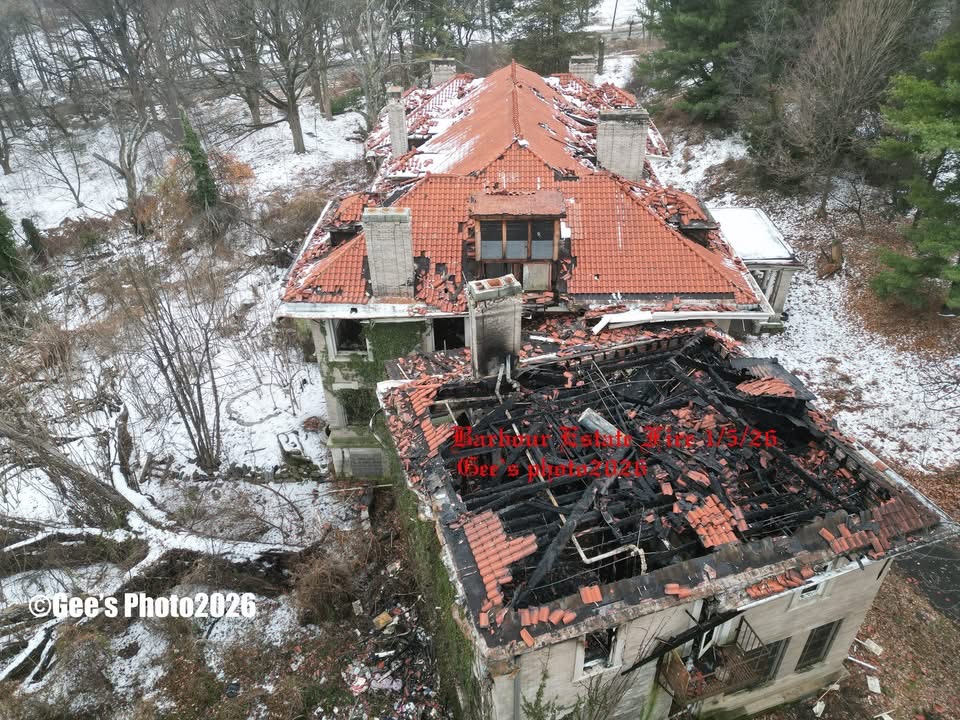
The Barbour Estate, also known as Kilbarchen, is one of Paterson, New Jersey’s grandest surviving historic estates and a lasting reminder of the city’s remarkable industrial past. Located atop the Broadway hill overlooking the Passaic River and Eastside Park, the estate was built in 1909 by John Edwards Barbour, a member of the influential Barbour family whose textile empire helped make Paterson one of the world’s leading manufacturing centers during the late nineteenth and early twentieth centuries.
The Barbour family’s roots in the linen and thread industry stretched back to 1739 in Scotland before expanding into Ireland. In 1864, brothers Thomas and Robert Barbour established their American operations in Paterson, where they built one of the nation’s largest flax and linen thread manufacturing enterprises. Their mills on Spruce Street and Grand Street employed thousands of workers—many recruited directly from Ireland—and became internationally known for producing high-quality linen thread, twine, and flax products. The Barbour companies played a major role in Paterson’s reputation as “Silk City,” even though their specialty was linen and flax rather than silk.
John Edwards Barbour, the son of Robert Barbour, commissioned the construction of Kilbarchen as the family’s principal residence. Designed in the Beaux-Arts style, the mansion occupied the highest point along Broadway, creating an impressive gateway into the city from the east. The residence reportedly contained 42 rooms, 12 fireplaces, elegant reception halls, finely crafted woodwork, stained glass, and even a built-in pipe organ. The expansive estate included landscaped gardens, carriage drives, ornamental iron fencing, and sweeping views of the Passaic Valley, reflecting the wealth and prominence of one of Paterson’s foremost industrial families.
The Barbour family was influential not only in industry but also in public life. Colonel William Barbour, a relative of John Edwards Barbour, hosted distinguished visitors including President William McKinley and accompanied General Ulysses S. Grant during his visit to Paterson. His son, Warren Barbour, later served as a United States Senator from New Jersey until his death in 1943, marking the end of the family’s political prominence.
Following the death of John Edwards Barbour in 1941, the estate entered a new chapter. In 1942, the property was purchased by the Paterson Orphans Asylum Association, which converted the mansion into an orphanage and children’s home. For decades, the former mansion served generations of children in need, becoming a familiar landmark to many Paterson residents. During this period, portions of the surrounding estate were sold or developed for institutional uses, including what later became Paterson Catholic High School.
Recognizing its architectural and historical importance, the City of Paterson designated the Barbour Estate as a municipal historic landmark in 2007, and it has also been recognized as eligible for listing on the National and State Registers of Historic Places. Preservation advocates consider the estate one of the city’s most significant surviving mansions because it represents both Paterson’s industrial prosperity and the legacy of the Barbour family, whose businesses shaped the city’s economy for nearly a century.
Although the mansion has experienced years of vacancy and deterioration, preservationists continue to advocate for its restoration and adaptive reuse. Various proposals have envisioned the estate as a community center, cultural venue, banquet facility, museum, or event space. Standing on its wooded hillside above Broadway, the Barbour Estate remains one of Paterson’s most recognizable historic landmarks and an enduring symbol of the city’s Gilded Age heritage. Its preservation offers an opportunity to protect an irreplaceable piece of New Jersey history while giving new life to one of Paterson’s architectural treasures.