Before European Settlement
Before 1600
- The Lenape (Delaware) Indians inhabit the Passaic River Valley for thousands of years.
- The Great Falls of the Passaic River serves as an important fishing and trading location.
Colonial Era
1678
- Dutch settlers begin purchasing land along the Passaic River.
1693
- The Acquackanonk Patent is granted, encouraging permanent Dutch settlement in the region.
1700s
- Farms, mills, and small settlements develop throughout what would later become Paterson.
The Birth of Paterson
1791
- Secretary of the Treasury Alexander Hamilton proposes using the Great Falls to power American industry.
- The Society for Establishing Useful Manufactures (S.U.M.) is chartered by the State of New Jersey.
1792
- Pierre Charles L’Enfant designs the raceway system to channel water from the Great Falls to factories.
- Construction begins on America’s first planned industrial city.
1794
- The first cotton mill begins operation.
Early Growth
1820s–1830s
- Textile production expands rapidly.
- Iron manufacturing and machine shops are established.
1835
- The Colt Gun Mill Strike, also known as the Baby Strike, becomes one of America’s earliest industrial labor protests.
1851
- Paterson is officially incorporated as a city.
1854
- John J. Brown becomes Paterson’s first mayor.
Industrial Expansion
1860s
- During the Civil War, Paterson factories produce locomotives, firearms, machinery, and military equipment.
1870s
- Paterson becomes the nation’s leading producer of silk, earning the nickname “Silk City.”
1872
- The Rogers Locomotive Works builds some of the world’s finest steam locomotives.
1880
- The Garret Mountain Riot follows the fatal shooting of John Joseph Van Houten during the annual German singing societies’ spring celebration.
The Gilded Age
1880s
- Large Victorian neighborhoods develop.
- Immigrants from Italy, Ireland, Germany, Eastern Europe, and the Middle East settle in Paterson.
1883
- Nathan Barnert begins his first term as mayor.
1888
- The first electric streetcars begin operating.
Innovation and Industry
1890s
- Paterson becomes one of the largest silk manufacturing centers in the world.
- Thousands of looms operate throughout the city.
1895
- The Lambert Castle (Belle Vista) is completed by silk manufacturer Catholina Lambert.
1896
- The Wright brothers purchase a Paterson-built engine component while developing their early aviation experiments.
The New Century
1902
- The Great Paterson Fire destroys hundreds of buildings in the downtown business district.
1903
- Wright Aeronautical engines continue to benefit from technology developed by Paterson machinists.
Labor History
1913
- More than 20,000 silk workers participate in the famous Paterson Silk Strike, one of the largest labor actions in American history.
- Labor leaders Elizabeth Gurley Flynn and “Big Bill” Haywood organize the strike.
World War I
1917–1918
- Paterson industries manufacture silk, aircraft engines, machine tools, and military equipment for the war effort.
Between the Wars
1920s
- Residential neighborhoods such as Hillcrest continue to expand.
- The city reaches one of its highest population levels.
1931
- Hinchliffe Stadium opens, becoming one of America’s premier Negro League baseball parks.
World War II
1941–1945
- Paterson industries produce aircraft engines, textiles, precision machinery, and military equipment.
- Thousands of local residents serve in the armed forces.
Postwar Years
1950
- Paterson’s population reaches approximately 140,000.
1950s–1960s
- Decline of the silk industry.
- Urban renewal projects reshape much of downtown.
- Interstate highways alter neighborhoods and transportation.
Modern Paterson
1971
- The Great Falls Historic District is added to the National Register of Historic Places.
1970s–1990s
- Paterson becomes one of New Jersey’s most culturally diverse cities, welcoming immigrants from Latin America, the Middle East, Asia, Eastern Europe, and Africa.
1992
- Paterson celebrates its Bicentennial (200th Anniversary).
Twenty-First Century
2009
- Congress establishes the Paterson Great Falls National Historical Park.
2011
- The National Historical Park officially opens under the National Park Service.
2012
- The Great Falls area becomes one of New Jersey’s newest National Parks.
2013
- Hinchliffe Stadium is designated a National Historic Landmark.
2023
- Hinchliffe Stadium reopens following a major restoration, once again serving as a community landmark.
Today
Paterson remains one of America’s most historically significant industrial cities. Its legacy includes:
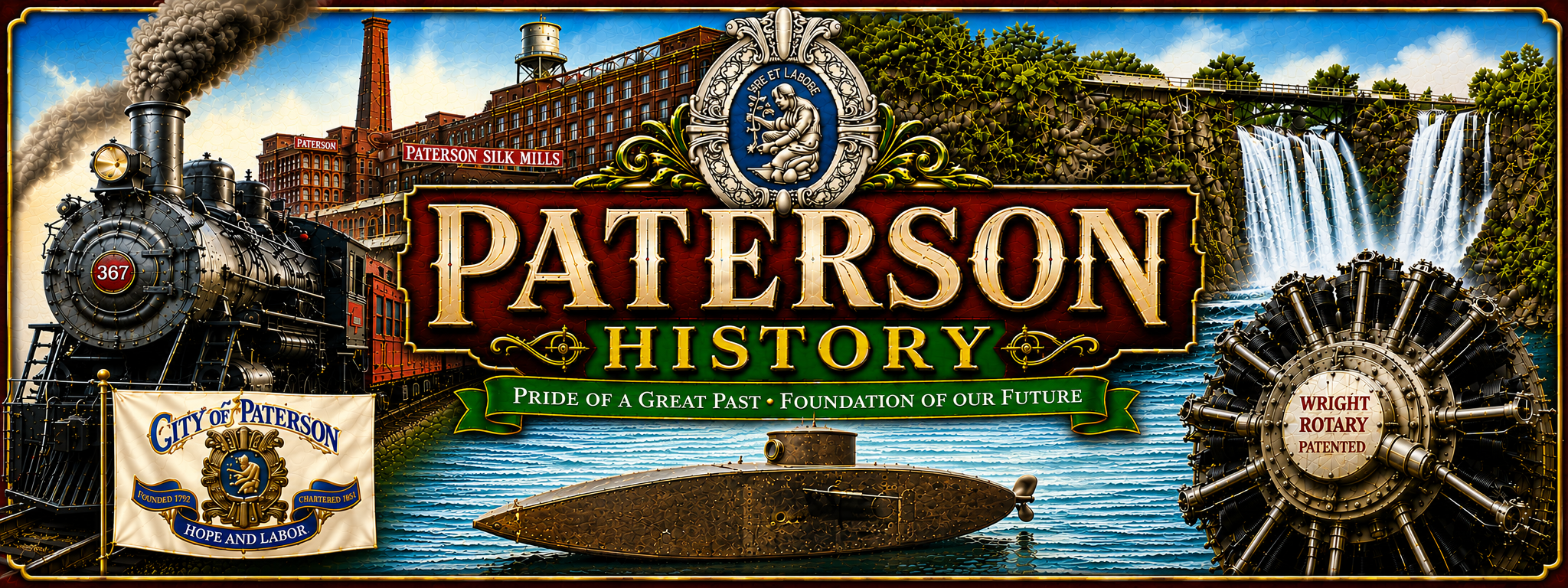
- The Great Falls of the Passaic River
- The Society for Establishing Useful Manufactures (S.U.M.)
- Silk manufacturing
- Locomotive construction
- Firearms manufacturing
- Aircraft engine innovation
- Labor reform
- Immigration and cultural diversity
- Historic architecture
- Paterson Great Falls National Historical Park
From Alexander Hamilton’s vision in 1791 to the vibrant and diverse city of today, Paterson continues to reflect more than two centuries of American industry, innovation, and resilience.