18th Century — The Founding of the Industrial City
| Year | Event | Significance |
|---|---|---|
| 1791 | Society for Establishing Useful Manufactures (S.U.M.) founded | Alexander Hamilton and others established the organization that would develop Paterson as an industrial center. |
| 1792 | Founding of Paterson | The S.U.M. purchased approximately 700 acres around the Great Falls, establishing what became America’s first planned industrial city. |
| 1793–1794 | Construction of the Raceway System | Engineers developed channels to divert water from the Passaic River and Great Falls to power factories. |
| 1794 | First major water-powered manufacturing begins | The Great Falls became the power source for Paterson’s developing textile and manufacturing industries. |
| 1796 | First S.U.M. manufacturing venture fails | The original company struggled financially, but the waterpower infrastructure remained the foundation of Paterson’s industrial future. |
Early Industrial Paterson
| Year | Event | Significance |
|---|---|---|
| 1812–1815 | War of 1812 industrial expansion | Paterson’s factories expanded production as American manufacturing became increasingly important. |
| 1820s | Growth of cotton and textile manufacturing | Paterson became a major American textile-producing center. |
| 1828 | Morris Canal reaches Paterson | The canal connected Paterson with the Delaware River and New York Harbor, greatly improving transportation. |
| 1832 | Locomotive manufacturing begins | Paterson entered the railroad manufacturing industry, eventually becoming one of America’s most important locomotive-producing cities. |
| 1835 | The “Baby Strike” | More than 2,000 workers, many of them young workers, participated in one of the nation’s earliest major industrial strikes. |
| 1840s | Silk manufacturing begins | Silk became an increasingly important part of Paterson’s industrial economy. |
| 1840s–1850s | Growth of locomotive manufacturing | Rogers and other manufacturers helped establish Paterson as a major railroad manufacturing center. |
| 1851 | Paterson incorporated as a city | Paterson formally became a city, reflecting its growing population and industrial importance. |
Civil War & Industrial Expansion
| Year | Event | Significance |
|---|---|---|
| 1861–1865 | Civil War manufacturing | Paterson factories produced locomotives, firearms, machinery, textiles and other materials important to the Union war effort. |
| 1860s | Silk industry expands | Paterson increasingly became a national center for silk manufacturing. |
| 1860s–1870s | Major immigration increases | Irish, German, Italian, Jewish, Eastern European and other immigrant communities transformed Paterson’s neighborhoods and workforce. |
| 1870s | “Silk City” emerges | Paterson became one of the world’s major silk manufacturing centers. By the late 19th century, nearly half of America’s silk was processed in Paterson. |
The Gilded Age
1880 — Garret Mountain Riot
One of the most important civil disturbances in Paterson’s history occurred during a German singing societies’ gathering at Garret Mountain.
The death of John Joseph Van Houten after he was shot led to a violent confrontation known as the Garret Mountain Riot.
This event deserves its own article because it involves:
- German-American organizations
- Politics
- Immigration
- Labor and class tensions
- The Paterson police
- Garret Mountain
- The German singing societies
It remains an important part of Paterson’s German-American history.
1880s–1890s — Paterson Becomes “Silk City”
| Period | Event |
|---|---|
| 1880s | Paterson becomes one of America’s largest silk-producing centers. |
| 1880s–1890s | Rapid construction of silk mills, worker housing and immigrant neighborhoods. |
| 1888 | Electric streetcars begin transforming transportation within the city. |
| 1890s | Paterson’s silk industry reaches international importance. |
| 1892–1895 | Major development of Garret Mountain estates, including Lambert Castle. |
| 1890s | Increasing labor unrest in the silk mills. |
| 1895 | Major Doherty & Wadsworth Silk Mill fire. |
| 1896 | Hinchliffe Brewery fire. |
| 1899 | Delaware, Lackawanna & Western railroad wreck — an important transportation disaster in Paterson’s history. |
Paterson Fire History maintains a particularly useful chronology of major fires and incidents extending from the 19th century through the present.
The Great Disasters of 1902–1903
🔥 February 9, 1902 — The Great Paterson Fire
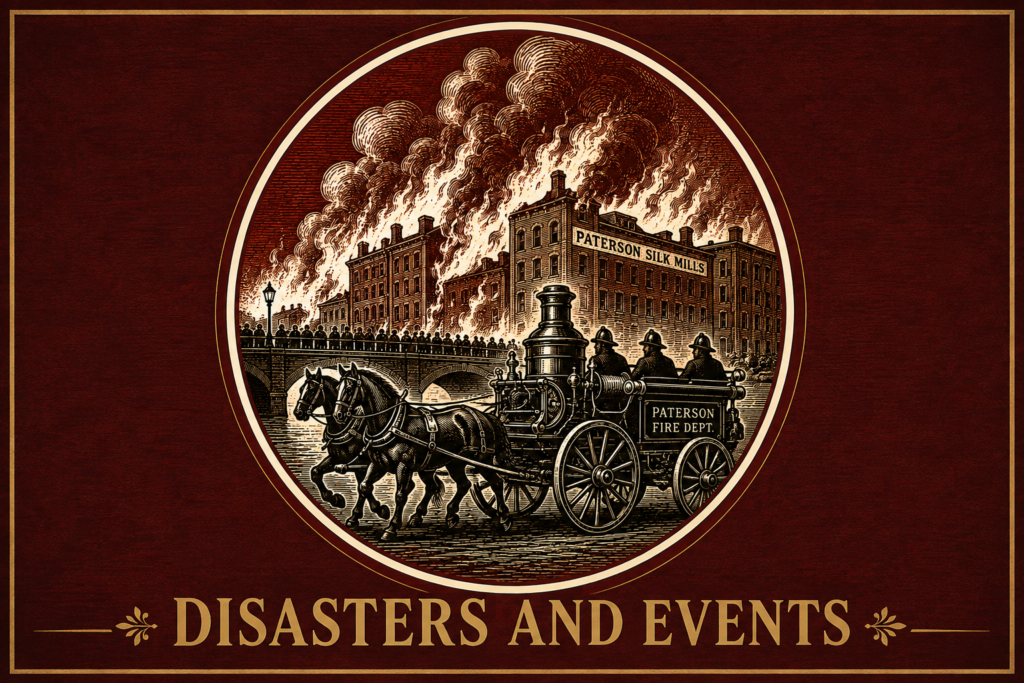
The Great Fire of 1902 was arguably the most devastating disaster in Paterson’s history.
The fire began around midnight in a streetcar barn and rapidly spread through the downtown area.
Approximately 456–459 buildings were destroyed, including:
- City Hall
- Churches
- Banks
- Businesses
- The Danforth Library
- Residential buildings
- Silk mills
- Commercial buildings
The fire transformed the appearance of downtown Paterson and led to extensive rebuilding with more fire-resistant construction.
🌊 March 1902 — The Great Flood
Only weeks after the Great Fire, Paterson suffered a catastrophic flood.
Heavy rain and snowmelt caused the Passaic River to rise dramatically.
The flood:
- Damaged silk mills
- Flooded residential neighborhoods
- Damaged bridges
- Closed transportation routes
- Damaged the raceway system
- Disrupted industrial production
The National Register documentation states that the river rose approximately 15 feet above normal and that property damage exceeded $1 million.
This combination makes 1902 one of the most extraordinary disaster years in Paterson history.
1903 — Major Flooding & Severe Weather
Paterson experienced additional serious flooding in 1903, including flooding beginning in October that exceeded the previous year’s event in height and damage according to historic documentation.
The early 1900s therefore represent a period of repeated natural and urban disasters.
1910s — Labor Conflict & Natural Disaster
1913 — The Great Paterson Silk Strike
February–July 1913
One of the defining events in Paterson history.
Approximately 20,000 or more silk workers participated in the massive strike against the city’s silk manufacturers. The strike lasted nearly six months and involved hundreds of mills and dye houses.
Important figures included:
- Elizabeth Gurley Flynn
- William “Big Bill” Haywood
- Carlo Tresca
- John Reed
- Industrial Workers of the World (IWW)
June 7, 1913 — Paterson Strike Pageant
More than 1,000 participants traveled to New York City for the famous Paterson Strike Pageant at Madison Square Garden.
This event deserves its own section because it connected Paterson’s labor struggle with the national labor movement.
July 1913 — Paterson Tornado
A major tornado struck the Paterson region in July 1913.
It caused extensive property damage and casualties and is among the important severe-weather events associated with Paterson’s history.
Important research note: historical accounts differ on some details of the tornado’s date, path and casualty figures. I would verify these against contemporary newspapers and National Weather Service records before publishing a definitive casualty count on the website.
World War I Era
| Year/Period | Event |
|---|---|
| 1914–1918 | Paterson factories contribute to wartime manufacturing. |
| 1917 | Major Salvation Army Mission fire. |
| 1918 | Influenza pandemic affects Paterson and its population. |
| 1918–1919 | Industrial production and employment affected by World War I and the influenza pandemic. |
1920s — Industrial Paterson
Important events include:
- Expansion of automobile transportation
- Continued silk manufacturing
- Decline of some traditional textile industries
- Growth of immigrant communities
- Continued labor organizing
- Major industrial and residential fires
- Development of new entertainment venues
1926 — Major Fires
Paterson experienced several significant multiple-alarm fires during the 1920s.
1928 — Linn Department Store Fire
The Linn Department Store fire is among the notable fires documented by the Paterson Fire Department’s historical records.
1930s — Depression, Industry & Disaster
1930 — Major Fires
The early Depression years brought numerous serious fires throughout the city. Paterson Fire Department records document numerous major incidents in 1930 alone.
1937 — Bestos Factory Explosion
The Bestos Factory explosion of 1937 is an important industrial disaster that should be included in a Paterson disaster chronology.
1938 — Quackenbush Fire
The Quackenbush fire of 1938 is another significant industrial/commercial fire documented in Paterson’s history.
World War II — 1941–1945
Paterson’s Wartime Industrial Mobilization
World War II was a major chapter in Paterson’s industrial history.
Paterson factories contributed to wartime production involving:
- Aircraft engines
- Machinery
- Textiles
- Metalworking
- Precision manufacturing
- Military equipment
The National Park Service recognizes Paterson as New Jersey’s American World War II Heritage City, reflecting the city’s contribution to the wartime home front.
1940s–1950s
Important events to document include:
- 1948 — First Christian Reformed Church fire
- Postwar industrial changes
- Decline of silk manufacturing
- Growth of new immigrant communities
- Expansion of automobile traffic
- 1953 — Wire Factory fire
- Continuing industrial accidents and mill fires
The city’s Fire Department historical database provides a useful chronology for this period.
1960s — Industrial Decline & Urban Change
The 1960s were a turning point in Paterson.
Important developments include:
- Decline of traditional textile manufacturing
- Factory closures
- Loss of industrial employment
- Urban renewal
- Highway planning
- Neighborhood displacement
- Increasing deterioration of historic industrial buildings
1963 — Franklin Finishing Company Fire
A significant industrial fire documented in Paterson’s fire history.
1965 — Dowling Coal Pocket Fire
Another notable industrial fire.
1968 — Midtown Hotel Fire
A major fire at the Midtown Hotel.
1969 — Kaysam Factory Fire
Important industrial fire during the period of Paterson’s manufacturing decline.
1970s — Urban Renewal & Preservation
1971 — Interstate 80 Construction
The construction of Interstate 80 dramatically changed Paterson.
It cut through established neighborhoods and affected:
- Homes
- Businesses
- Historic railroad infrastructure
- The former Morris Canal
- Historic neighborhoods
The National Park Service notes that the highway construction cut through neighborhoods, railroads and remnants of the Morris Canal.
1970s — Historic Preservation Movement
Grassroots preservation efforts began gaining momentum.
Citizens and preservationists worked to protect:
- Great Falls
- Historic mills
- Raceways
- Historic homes
- Downtown buildings
- Industrial heritage
These efforts eventually contributed to the preservation of the Great Falls/S.U.M. Historic District.
1980s — Historic Preservation
1980 — Cliffside Dye Fire
Important industrial fire.
1981 — Park Avenue Tenement Fire
Significant residential fire.
1984 — Alexander Hamilton Hotel Fire
Major historic-building fire that should be included in a Paterson fire-history section.
1980s — Growing Historic Preservation Movement
Paterson’s industrial heritage increasingly became recognized as nationally significant.
1990s
Important events include:
- Continued industrial decline
- Downtown redevelopment efforts
- Preservation of historic mill buildings
- 1991 — Meyer Brothers fire
- 1997 — Hinchliffe Brewery fire
- Increasing recognition of Great Falls as a nationally significant historic site
2000s
2000s — Great Falls Preservation
Paterson’s Great Falls and surrounding industrial district increasingly became the focus of preservation, tourism and redevelopment.
2009 — Great Falls National Historical Park
The establishment of Paterson Great Falls National Historical Park marked a major milestone in the preservation of Paterson’s industrial history.
The National Park Service now describes Paterson as America’s first planned industrial city, established around the Great Falls in 1792.
2010s
2011 — Hurricane Irene
Paterson and the Passaic River experienced significant flooding during Hurricane Irene.
2012 — Hurricane Sandy
Paterson experienced flooding, power outages and infrastructure impacts associated with Hurricane Sandy.
2015 — Paterson Armory Fire
The Paterson Armory fire is among the major fires documented in the city’s modern history.
2019
Straight and Narrow Fire
A significant fire at the Straight and Narrow complex became another important modern Paterson fire.
2020s
2021 — Hurricane Ida
One of the most important recent natural disasters for Paterson was Hurricane Ida.
The storm produced catastrophic flooding throughout northern New Jersey, including serious flooding along the Passaic River and in Paterson.