Home – History – Designations – Present – Future – Photo Gallery – How you can help – In The News – Contact Us
Eastside Presbyterian Church
Founded 1882
In the late 1870s and early 1880s, the Eastside section of Paterson was sparsely settled. The only means of public transportation between Eastside and the center of Paterson was the Paterson Horse Railway Company. The company operated horse cars during the good weather and used bobsleds when necessary during the winter months. One line ran from Park Avenue to Vreeland Avenue and south to the gates of Cedar Lawn Cemetery.
The horse cars made trips at 40 minutes intervals during the day and ran until nine o’clock at night. On Sunday hourly trips were scheduled. Another line ran east on Broadway to 24th Street to 15th Avenue and then east to Vreeland Avenue, which was the end of the line. The operating schedule on this line consisted of regular trips every hour during the week and trips every two hours on Sunday. Some of the more affluent residents of Eastside owned horses and carriages, and reportedly one resident drove down Willis Street (Park Avenue) behind a yoke of oxen, but many residents relied on horse car transportation. This made it difficult to attend church services in downtown Paterson.
In 1880, Presbyterians living in the area formed the Eastside Presbyterian Association. The group was composed of members of the three Paterson Presbyterian Churches: the “First” located on Main Street, the “Second Presbyterian” located on the corner of Church and Ellison Streets, and the “Third Presbyterian” on Grand Street.
The Association began holding weekly prayer meetings in various homes. These meetings became very popular with the residents and were well-attended. On June 10, 1880, a meeting was held at George Coulsen’s home on Vreeland Avenue to discuss the feasibility of building a Sunday School where mid-week religious services could be held. A decision was made to build a chapel in the Eastside. Six lots at the northwest corner of Willis [now Park Avenue) and East 29th Street were purchased for $2,000. An “Old English” style chapel was designed by L. B. Valk of New York, the same architect who designed the Second Presbyterian Church.
The church, 36 feet by 80 feet, was built on two of the lots on East 29th Street. The sidewalls were low, the roof was very steep, the windows were made of stained glass, and the interior was richly furnished with semi-circular seats of black walnut. The cost of the building was $5,700. Craftsmen who worked on the building were Henry Platt, mason; Andrew Hopper, carpenter, Robert Garrison and James Sigler, painters. Inglis & Hubbard Co. were responsible for the fine wood work, doors and seats.
The chapel was formally opened on Sunday, January 8, 1881. Services were conducted by George J. Coulson, president of the Eastside Association. initially, use of the chapel was limited to a session of the Sunday School at 2 p.m. each Sunday, prayer meetings on Wednesday nights and Bible classes on Friday nights. The sudden death of Mr. Coulson, a tower of both spiritual and financial strength, was a shock to the congregation.
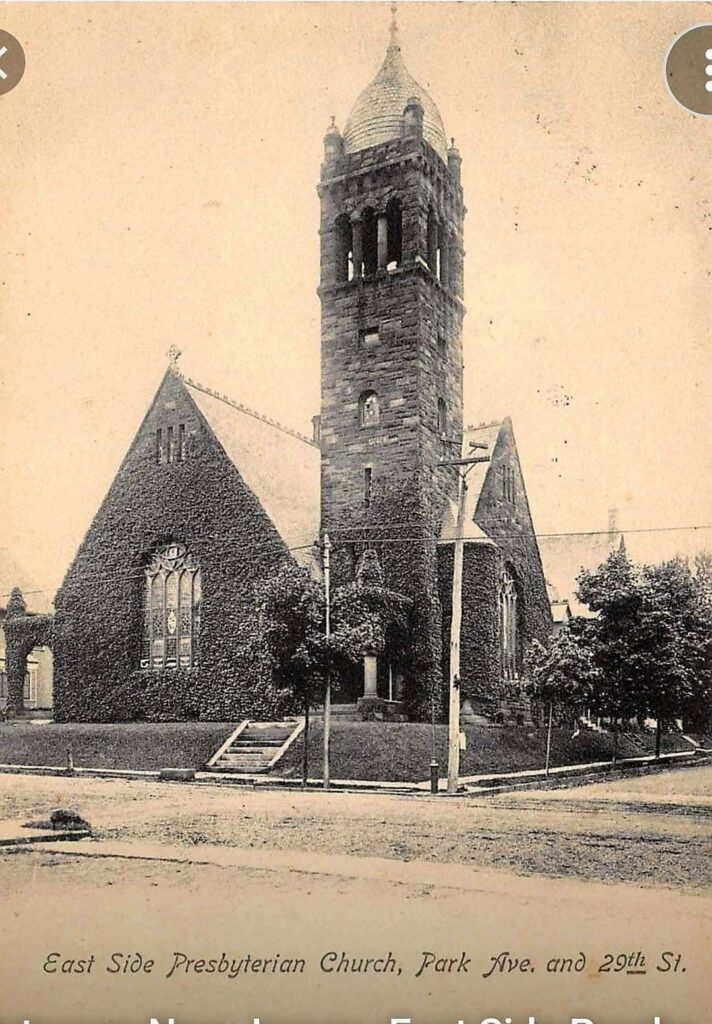
The Eastside Church was formally organized in the Jersey City Presbytery on May 5, 1881, largely through the influence of Watts Cooke, then secretary of the Rogers Locomotive Works. In March 1883, Rev. Samuel Carlisle became the church’s first pastor. Eastside was becoming the most popular residential section of the city, therefore it was deemed necessary by the Presbytery that a church should be located in the immediate vicinity. A larger church was erected in 1887 at 431 Park Avenue on the corner of Park Avenue and East 29th Street. The cornerstone was laid on June 16, 1887, and the dedication was held on November 20, 1888.
The new church grew in numbers as did the Sunday School. The holiday season was filled with many festivities, and the annual Sunday School picnic drew over four hundred people. it was one of the highlights of each year. Picnics were held in Coulson’s Woods. People were transported to the picnic site by lumber and farm wagons pulled by horses loaned by the Rolling Mill and Inglis and Hubbard. During the winter season there were skating parties on Carr’s Pond, Dean’s Pond and the “Slank.” Sleighing parties were also a popular form of amusement.
Rev. Carlisle resigned on January 13, 1892, and was followed by Rev. Charles J. Young; however, Rev. Young was never installed. After nine months of service, he accepted a call elsewhere.
ln 1901, Mrs. Robert Barbour and children added a completely furnished Sunday School room as a memorial to her deceased daughter, Mary Barbour, a young bride of less than a year. Mary had been a devoted worker in the Sunday School. On April 15, 1907, property adjacent to the chapel at 626 East 29th Street was purchased. It was used for recreational purposes and as an expansion of the Sunday School.
Another addition to the church was made in 1922-1923 during the pastorate of Rev. Wilson T. M. Beale. Dr. Beale resigned his position on September 14, 1923, two days after the renovated church was opened. The next venture undertaken by the congregation was the purchase of a church manse. Property at 4-11 Fifteenth Avenue was obtained for that purpose in 1929.
By 1940, the small band of 35 worshipers in 1882 had expanded to total more than 800, only to drastically decline during the next forty years. By the 1980s, the church was in the throes of an economic and spiritual struggle. The large building was expensive to maintain and church attendance was low. The congregation voted to disband. The last service was held on June 29, 1986.
The building was then occupied by the Friendship Baptist Church.
Clergy:
(Approximate dates)
Rev. Samuel Carlisle 1883-1892
Rev. Charles]. Young 1892
Rev. James H. Owens 1894-1913
Rev. Wilson T. M. Beale 1914-1923
Rev. Howard A. Adair 1924-1953
Rev. James D. Boysell 1953
Rev. William]. Steipstra
Rev. Leslie A. Depenbrock
This exerpt is from:
Ecclesiastical
History
of Paterson, NJ
By Annita Zalenski and Robert J Hazekamp Jr.
Passaic County Historical Society Genealogy Club
Published: 2011
Built in 1887 the Eastside Presbyterian Church was made of brown sandstone from Devlin’s quarry at Garret Mountain. The Gothic style church has a tower 100 feet high topped with a bell shaped cupola. The interior features two chandeliers each with 100 gas jets to furnish light, 102 pews made of quartered oak, each cushioned with olive hand woven linen and silk to seat 575 people.