Van Houten House
Van Buren Farmhouse
The Great Falls National Park
City Hall
Passaic County Court House
Passaic County Courthouse Annex (Former U.S. Post Office)
Lambert Castle
Spruce Street Bridge
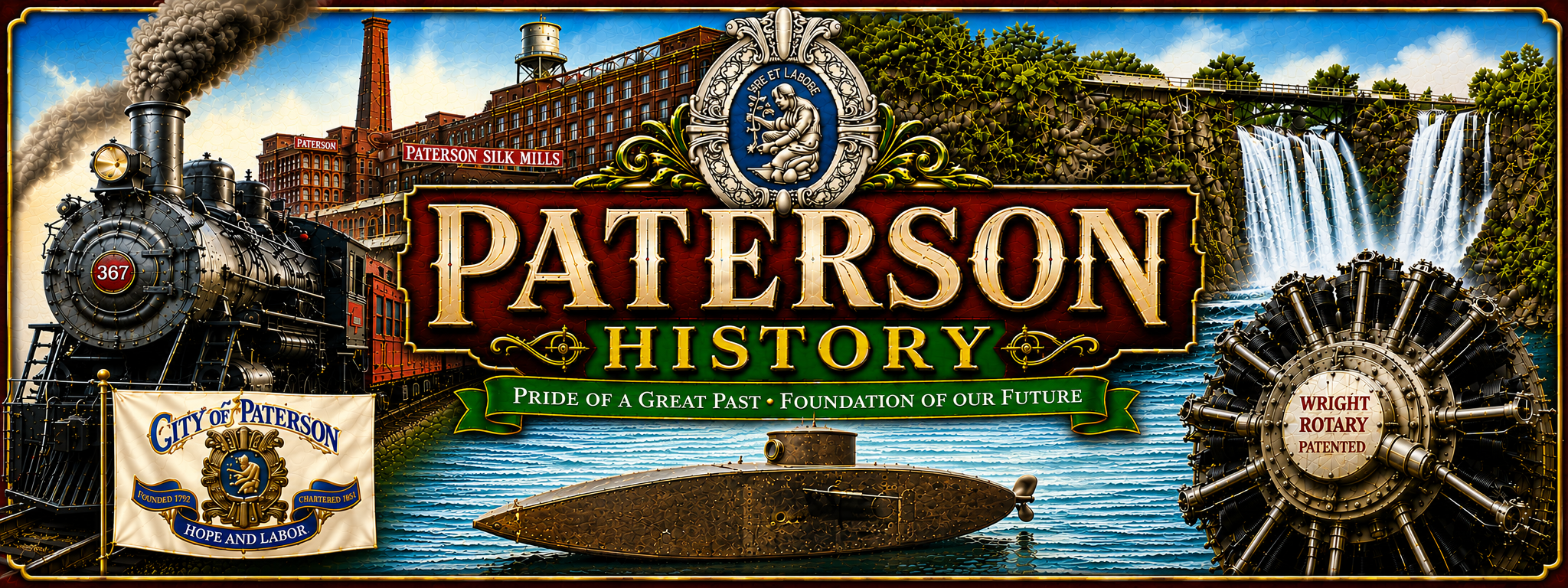
Founded in 1792 as America’s first planned industrial city, Paterson possesses one of the richest collections of historic landmarks in New Jersey. These sites tell the story of industry, immigration, religion, labor, transportation, and civic life that shaped both the city and the nation.
Great Falls of the Passaic River
The Great Falls is Paterson’s best-known landmark and one of the largest waterfalls east of the Mississippi River. Dropping approximately 77 feet, the falls inspired Alexander Hamilton to establish America’s first planned industrial city.
The falls powered the factories that produced cotton textiles, locomotives, Colt revolvers, silk, aircraft engines, and countless other products. Today the falls are the centerpiece of Paterson Great Falls National Historical Park, established in 2011 and preserving the birthplace of America’s Industrial Revolution.
The Society for the Establishment of Useful Manufactures (S.U.M.) Raceway System
Constructed beginning in the 1790s, the three-level raceway system diverted water from the Great Falls to power factories throughout the city. Designed by Pierre Charles L’Enfant and later expanded by other engineers, the raceways remain one of the finest surviving examples of early American industrial engineering.
The canals powered hundreds of mills for more than a century and remain one of Paterson’s greatest engineering achievements.
Paterson Great Falls National Historical Park
Created by Congress in 2009 and formally established in 2011, the National Historical Park preserves the Great Falls, raceways, historic mill buildings, hydroelectric plant, and surrounding industrial district.
The park interprets Paterson’s contributions to manufacturing, immigration, labor history, and technological innovation.
Rogers Locomotive and Machine Works
Founded in 1832, Rogers Locomotive Works became one of the world’s leading builders of steam locomotives. The company produced more than 6,000 locomotives, including famous engines such as the General, which participated in the Civil War’s Great Locomotive Chase.
The surviving erecting shops now house the Paterson Museum and remain among the city’s most significant industrial landmarks.
Paterson Museum
Located in the former Rogers Locomotive erecting shop, the Paterson Museum preserves the city’s industrial heritage through exhibits on locomotives, silk manufacturing, Colt firearms, aircraft engines, the Holland submarine, and local inventions.
Its collections make it one of New Jersey’s premier industrial history museums.
Hinchliffe Stadium
Completed in 1932, Hinchliffe Stadium is one of only a handful of surviving Negro League baseball stadiums in the United States.
Home to the New York Black Yankees and numerous legendary athletes, the stadium also hosted football games, boxing matches, concerts, and civic celebrations. Following a major restoration completed in 2023, it has returned to active use while preserving its historic significance.
Lambert Castle
Built in 1892 by silk manufacturer Catholina Lambert, Lambert Castle overlooks Paterson from Garret Mountain. Designed in the style of an English medieval castle, it served as Lambert’s residence before becoming the home of the Passaic County Historical Society.
Today it houses museum exhibits documenting the history of Passaic County and Paterson.
Garret Mountain Reservation
The 568-acre Garret Mountain Reservation offers panoramic views of Paterson and northern New Jersey. Besides its scenic beauty, it contains Lambert Castle, historic carriage roads, and several monuments commemorating local history.
The mountain has long served as one of the city’s most treasured public recreational areas.
St. John’s Cathedral
The Cathedral of St. John the Baptist is among Paterson’s most impressive Gothic Revival churches. Construction began in the 1860s, and its towering spire dominates the city’s skyline.
The cathedral has served generations of Irish, Italian, Polish, Hispanic, and other Catholic communities and remains the seat of the Diocese of Paterson.
St. Joseph’s Roman Catholic Church
One of Paterson’s finest nineteenth-century churches, St. Joseph’s served thousands of immigrant families who worked in the city’s mills and factories. Its Gothic architecture remains an important landmark within the Great Falls Historic District.
City Hall
Completed in 1896, Paterson City Hall is one of New Jersey’s finest examples of Beaux-Arts civic architecture. Inspired by the Hôtel de Ville in Lyon, France, the building symbolizes the city’s prosperity during the height of the silk industry.
It continues to serve as the center of municipal government.
Passaic County Courthouse
The Passaic County Courthouse is one of downtown Paterson’s most distinguished public buildings. Designed in the Beaux-Arts style, it reflects the city’s growth and civic importance during the early twentieth century.
The Silk Mill District
Throughout downtown and the Great Falls area stand dozens of surviving brick silk mills dating from the late nineteenth and early twentieth centuries. These include the Riverside Silk Mill, Hamilton Mill, Essex Mill, and numerous former ribbon and broad silk factories.
Collectively they represent the era when Paterson produced nearly half of all the silk manufactured in the United States.
Lou Costello Memorial
Paterson proudly honors comedian Lou Costello, one half of the legendary comedy team Abbott and Costello. A bronze statue in Lou Costello Memorial Park commemorates his childhood in the city and his enduring contribution to American entertainment.
Eastside Park
Designed by the renowned Olmsted Brothers landscape architecture firm, Eastside Park has served as one of Paterson’s premier public parks since the early twentieth century. Its walking paths, formal landscaping, monuments, and recreational facilities continue to make it a centerpiece of community life.
The Botto House (American Labor Museum)
Although located just outside Paterson in neighboring Haledon, the Botto House played a central role during the Great Paterson Silk Strike of 1913. It served as a gathering place for thousands of striking workers and today houses the American Labor Museum, preserving one of the most important chapters in American labor history.
Historic Churches
Paterson’s skyline is defined by numerous historic churches reflecting the city’s remarkable ethnic diversity. Among the most significant are:
- Cathedral of St. John the Baptist
- St. Joseph’s Roman Catholic Church
- St. Michael’s Roman Catholic Church
- First Presbyterian Church
- First Baptist Church
- Second Baptist Church
- Canaan Baptist Church
- St. Luke Baptist Church
- First African Methodist Episcopal Zion Church
These congregations served generations of immigrants and remain important cultural and architectural landmarks.
Historic Neighborhoods
Several neighborhoods preserve the city’s architectural heritage:
- Great Falls Historic District
- Eastside Historic District
- Hillcrest Historic District
- Totowa Section
- South Paterson
- Washington Market Historic District
Each reflects different periods of Paterson’s growth and the diverse communities that helped build the city.
Legacy
Paterson’s landmarks represent far more than impressive buildings or scenic places. They tell the story of America’s Industrial Revolution, the growth of organized labor, waves of immigration, remarkable engineering achievements, and the entrepreneurial spirit that transformed a waterfall into one of the nation’s greatest manufacturing centers.
Together, these landmarks make Paterson one of the most historically significant cities in the United States, preserving a legacy that continues to educate and inspire future generations.