Mayor
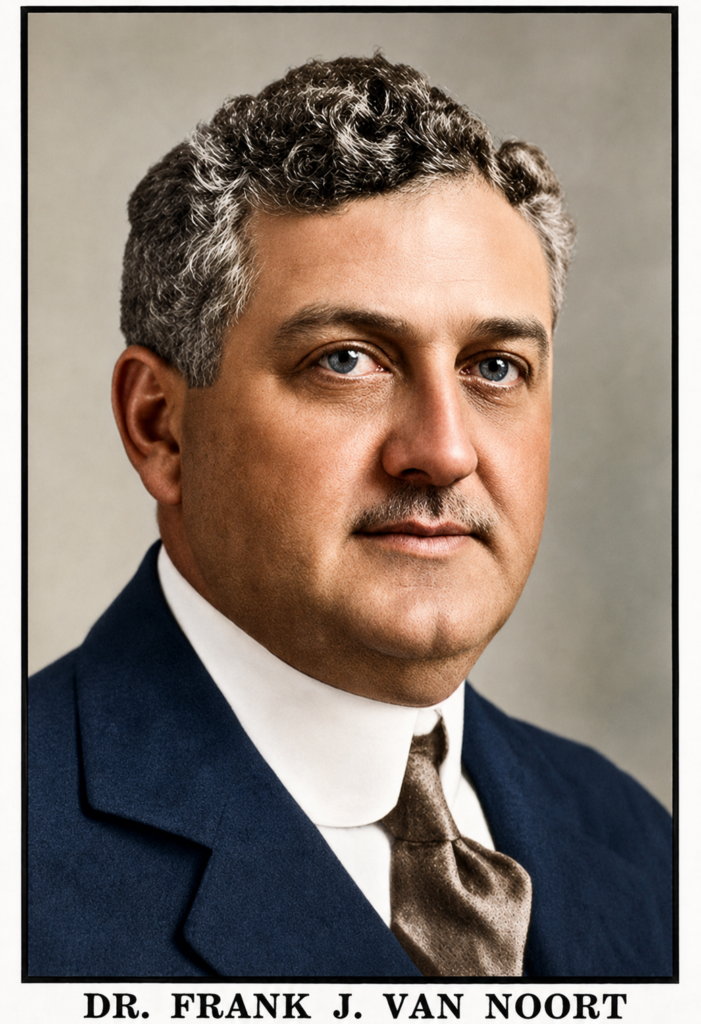
Frank J. Van Noort
1920-1923
Frank Joseph Van Noort was born on December 15, 1869, and raised in Paterson’s predominantly Dutch Over the River neighborhood. Leonardus and Catherine Van Noort raised their family on the corner of N. Main Street and Arch Street where Leonardus operated a saloon. They had met and married in Bridgeport, Connecticut in 1853–he an immigrant from the Netherlands and she from Ireland. In 1861 they moved to Paterson, then to New York City, before settling for good in Over the River in 1865.

(Sanborn map 1887, Princeton University)
Frank was the youngest of their ten children, eight of whom lived to adulthood. The saloon was the neighborhood social center and served as the meeting place for the First Ward Democratic Club. It was used as a polling station, too. During election campaigns, the election banners suspended over North Main Street were anchored to the side of the building. Growing up in this sociable place taught Frank a great deal about getting along with people and human nature.

Two things distinguished the Van Noorts from the majority of Over the River’s Hollanders: None of the family permanently worked in the textile mills and on Sundays they attended mass at St. John the Baptist Roman Catholic Church. There they came under the influence of Dean William N. McNulty, one of Paterson’s civic leaders–and its most prominent Roman Catholic–for almost sixty years.

Frank attended St. John’s Catholic School and graduated from Paterson High School in 1887. A few years later he enrolled at Seton Hall College and graduated in 1894. He then earned a medical degree at Cornell University, graduating in 1899. When Leonardus died in 1895, Catherine moved to a house on Main Street, half a block from St. John’s. Frank set up his practice in this house and lived there with his mother and sister Jane. Their next door neighbor was Dr. Andrew F. McBride, a physician, fellow parishioner at St. John’s, and active Democrat who became “Paterson’s Best Mayor” during his six years (1908-14) in city hall.

Within a few years, Van Noort began spreading his political wings. He was appointed school inspector in 1900, city physician in 1902, county asylum physician a few years later, and a member of the Passaic Valley Sewer Commission. In 1906 he was elected county sheriff on the Democratic ticket. In 1909 he challenged Mayor McBride for the Democratic nomination and lost handily. Van Noort’s charge of nepotism persuaded few of the party faithful to abandon the popular McBride. Van Noort’s claim that he would not allow Republican members of the Hamilton Club to dictate city appointments also fell flat, considering how he was himself a member of the club.

Frank maintained his medical practice while he served as sheriff. He also devoted his time to several fraternal organizations (Red Men, Eagles, Elks), the Knights of Columbus, the Democratic Party, and the Hamilton Club. From these social connections came business opportunities. In 1913 he helped organize the Center Paper Box Company which opened a factory in the Bunker Hill neighborhood. He served as its president for many years.

In the spring of 1918, with the United States involved in the First World War, Van Noort volunteered to serve as a doctor in the army. For almost a year he was assigned to a military hospital on Staten Island where he treated victims of the influenza epidemic and war-related injuries. Five months after the Armistice ended the fighting, Van Noort was discharged with the rank of captain. He returned to Paterson, closed his private medical practice, and devoted himself full-time to the box factory. That fall, politics beckoned him again.

Paterson’s acting mayor, Clifford Newman, had taken office when Mayor Amos Radcliffe resigned to take a seat in the United States House of Representatives in March 1919. Van Noort was urged to run for mayor by his friends in the Democratic Party. He won the party’s nomination in September and campaigned for office at Capt. Frank J. Van Noort, MD–a veteran and a doctor, someone above the partisan fray. He accused Newman of wild spending. Newman accused Van Noort of being a career politician who had no administrative experience, especially with finances. When the votes were counted on November 4, Van Noort had been elected by the margin of a mere 108 votes out of over 18,000 votes cast. He took office on January 1, 1920.
As mayor, Van Noort built on McBride’s legacy: parks, schools, reliable municipal services, infrastructure, fiscal responsibility, public health. Streets were paved, sidewalks built, parks expanded and refurbished. School teacher salaries were increased. Women were placed on an equal basis with men for promotion to the role of principal in the public school system. Negotiations continued with the Erie Railroad to eliminate grade crossings in the downtown area. Van Noort did not forget to reward his friends with jobs; he even appointed his brother John to the office of Receiver of Taxes. But his term was remarkably free of scandal.

As election day approached, Van Noort was hospitalized with a burst appendix. Andrew McBride, St. Joseph’s Hospital’s head surgeon, supervised Van Voort’s care. The mayor spent election day in the hospital. When the votes were counted, he had won re-election by the widest margin any mayor had received in over twenty years. Even though he did not carry heavily Republican the Over the River neighborhood, he did make inroads in the heavily Dutch Protestant precincts.
While Van Voort never stressed his Dutch roots, he did not walk away from them. He very publicly endorsed a letter campaign in the public schools that encouraged students to write notes to the queen and princess heir in the Netherlands. When the local Holland Home campaigned to fund a sizeable addition, Van Noort praised their efforts. As was the case for many Dutch Catholics, his view of the old country was tempered by the discrimination that had prompted people like his father to leave. Rather than being a Dutch Catholic, Van Noort was a more Catholic who was part Dutch.

His lifelong association with Paterson’s Catholic patriarch, Dean William N. McNulty, reflected that truth. While McNulty established parishes for the city’s various ethnic groups–including the predominantly Dutch Our Lady of Lourdes in the Riverside neighborhood–he also encouraged his flock to Americanize. Dutch Catholics tended to marry within their parishes, but frequently their spouses were from other ethnic groups, much like Van Noort’s own parents.
McNulty’s longevity and his ecumenical spirit transformed him into a revered presence in the city. The stories about him were legendary: from the time he singled-handedly ended a May Day riot between German and Irish Catholics on Garret Mountain, to the fear he struck into the hearts of his parishioners when he entered a saloon on Saturday to send them home before they drank their weekly wages. The saloonkeepers were said to fear him more than the police when he would personally enforce the Sunday closing laws, armed with an umbrella to clear the bottles and glasses from the bar and tables.
McNulty’s death at the age of ninety-three on June 18, 1922, inspired an ecumenical outpouring of praise for what he had done to make Paterson a better place. Surrounded by an Episcopal rector, a Jewish former mayor, the president of the chamber of commerce, and two more local noteworthies, Van Noort signed a proclamation that extolled McNulty as “a staunch upholder of …good citizenship and civic pride…”, and a patriot with an “…interest in the welfare and progress of the community….” From these whereases came the therefore asking Patersonians “…regardless of color, nationality or creed to join tomorrow in paying tribute and reverence to the memory of the “Grand Old Man” who has passed….” He asked that, if convenient, all activities cease in the city for two hours, beginning at 10:00AM and that all flags be flown at half-staff. The superintendent of schools announced classes would be suspended from 9:30AM until 1:00PM.

At this, the local Ku Klux Klan chapter issued a protest. They sent a public letter to Van Noort and the newspapers denouncing this “violation” of the separation of church and state. Even though Van Noort had stressed McNulty’s civic contributions only, the Klan contended that the schools were being closed to honor a Catholic priest. The local newspapers denounced the charge; Van Noort remained silent. He would not dignify the charge with an answer. The outcry against the Klan statement was so loud, the state Klan organization disavowed any connection to the charge. While the Klan backed down in the face of public opposition in this instance, a few weeks later crosses burned on Garret Mountain for all to see throughout the city.

McNulty’s funeral took place on June 22. Upwards of 20,000 came to pay tribute at the church and along the route to the cemetery. The priest who died in the hospital he founded, was honored by a requiem mass in the church he built. He was buried in the cemetery he had organized on the west edge of the city’s Totowa section. Mayor Van Noort led the official mourners.
When he ran for a third term in 1923, Van Noord faced stiffer political headwinds. The Evening News turned on him, alleging he had betrayed the voters with extravagant spending (including expensive cars city officials rode in), packing offices with his friends, and trying to buy the favor of the Evening News’s publisher with a public office. Headlines screamed with accusations that the mayor protected the city’s bootleggers. Van Noort countered with statistics to prove the city’s finances were sound and accusing his Republican opponent of supporting the Ku Klux Klan. It did not help when the state health department issued a public letter to Van Noort asking that the city government act to suppress the dramatic increase in venereal disease cases being reported locally. The barrage of bad press took its toll and he lost by about 2100 votes. Van Noort’s electoral career was over.

He continued to operate the Center Paper Box Company for several years. He was appointed to various political positions in the city and county. He also experienced setbacks, most notably a bankruptcy in 1938. When he died in 1954, Van Noort was remembered as a genial, civic minded asset to the community. Like Dean McNulty, Frank Van Noort tried to make the world better for others. For Van Noort that meant healing the sick as a doctor and building a better Paterson as a politician. But the most publicized thing he did was to say “no” to the Ku Klux Klan when he decided to lower the flags and allow the school children to line the route to Holy Sepulchre Cemetery to honor of the honorable priest who was Paterson’s “grand old man.”