William Strange Lived at 553 Park Ave.
William Strange was one of the most influential pioneers of Paterson’s silk industry during the nineteenth century. Along with John Ryle and Catholina Lambert, he is widely regarded as one of the three men whose leadership transformed Paterson into America’s “Silk City.”
Early Life
William Strange was born in England and immigrated to the United States with his family during the 1830s. His father, A. B. Strange, established Strange & Brother in Williamsburg, Brooklyn, in 1838 as a silk-importing business specializing in ribbons and luxury silk goods. For many years the firm imported fine European ribbons rather than manufacturing them.
Entering Silk Manufacturing
During the Civil War era, several factors encouraged the company to manufacture silk products in America:
- Customers increasingly wanted custom ribbon colors.
- High tariffs made imported silk products more expensive.
- American manufacturing technology was rapidly improving.
In 1863, Strange & Brother began producing silk ribbons in Brooklyn using machinery purchased from the English firm John Day & Co. The venture proved highly successful.
Moving to Paterson
Recognizing Paterson’s advantages—including skilled textile workers, available water and steam power, and an expanding silk industry—William Strange moved his manufacturing operations to Paterson in 1868.
Initially he rented space in the Greppo Mill on Slater and Dale Avenues. Demand for his ribbons quickly exceeded the available space.
Building the William Strange Mills
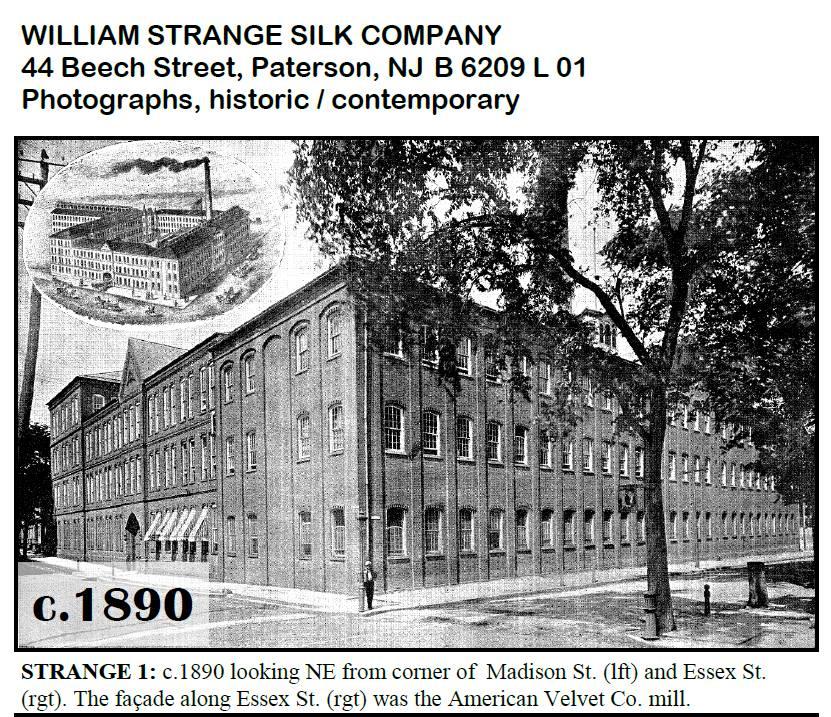
In 1874 Strange purchased the former American Velvet Company mill at Madison and Essex Streets.
Over the next decade he transformed the property into one of Paterson’s largest ribbon-manufacturing complexes:
- 1874 – Purchase of the American Velvet mill.
- 1878 – Major additions along Beech Street.
- 1883 – Construction completed around a central courtyard containing boilers and engines.
- By 1890 – Approximately 800 workers were employed.
- By the early 1880s the company operated hundreds of looms and thousands of spindles, making it one of America’s largest silk ribbon manufacturers.
The factory occupied nearly an entire city block bounded by Madison, Essex, Beech, and Morton Streets.
National Leader in the Silk Industry
William Strange became one of the nation’s foremost authorities on silk ribbon manufacturing.
He served as:
- President of the Silk Association of America
- President of the Paterson Board of Trade
- Member of Paterson’s Parks Commission
His advocacy helped establish American-made silk as a high-quality alternative to imported European products.
Civic Contributions
Beyond manufacturing, Strange was deeply involved in Paterson’s civic development. His service on the Parks Commission helped lay the groundwork for the city’s expanding public park system during the 1890s.
He was also active in promoting Paterson as the nation’s leading silk manufacturing center.
Death and Legacy
William Strange died in 1899.
Following his death:
- The silk manufacturing machinery was sold.
- His estate retained ownership of the mill buildings.
- The complex continued to house other industrial tenants.
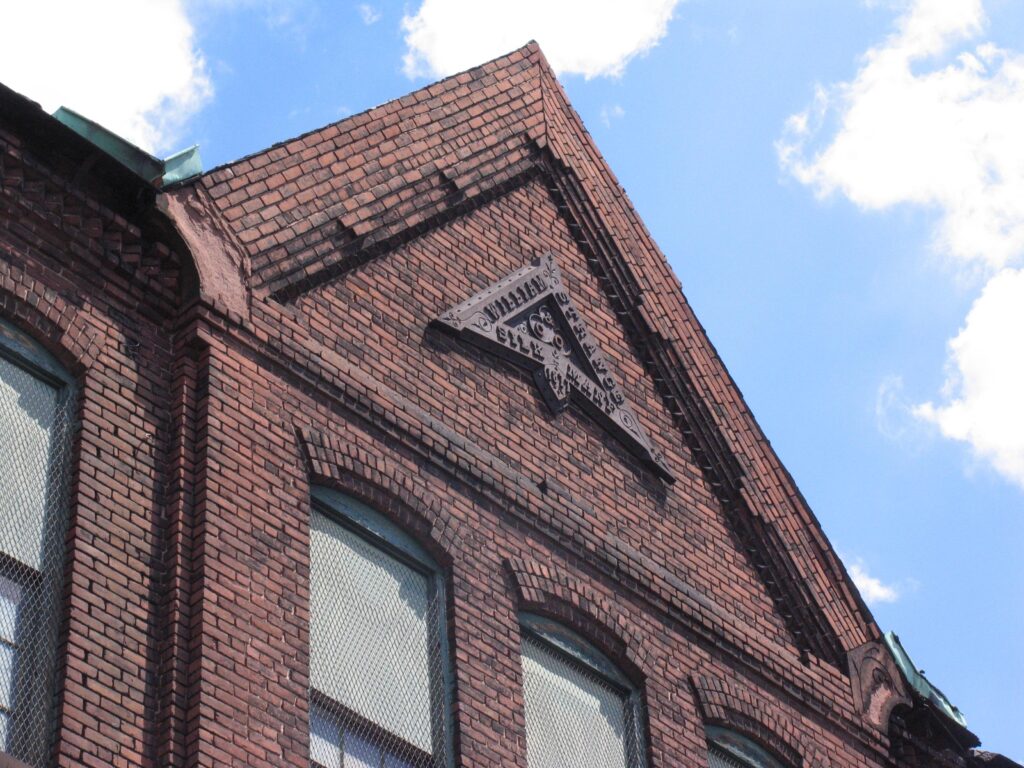
Today, the William Strange Mills remain among the oldest surviving silk mill buildings in Paterson and have been recognized as historically significant for both their industrial architecture and their association with one of the city’s foremost silk manufacturers.
Historical Significance
William Strange’s greatest achievement was proving that American manufacturers could equal—and often surpass—the quality of imported European silk ribbons. His success helped make Paterson the undisputed center of the American silk industry by the late nineteenth century.
His mill complex survives as one of the city’s most important industrial landmarks, symbolizing the era when Paterson produced a substantial share of the nation’s silk ribbons and textiles.