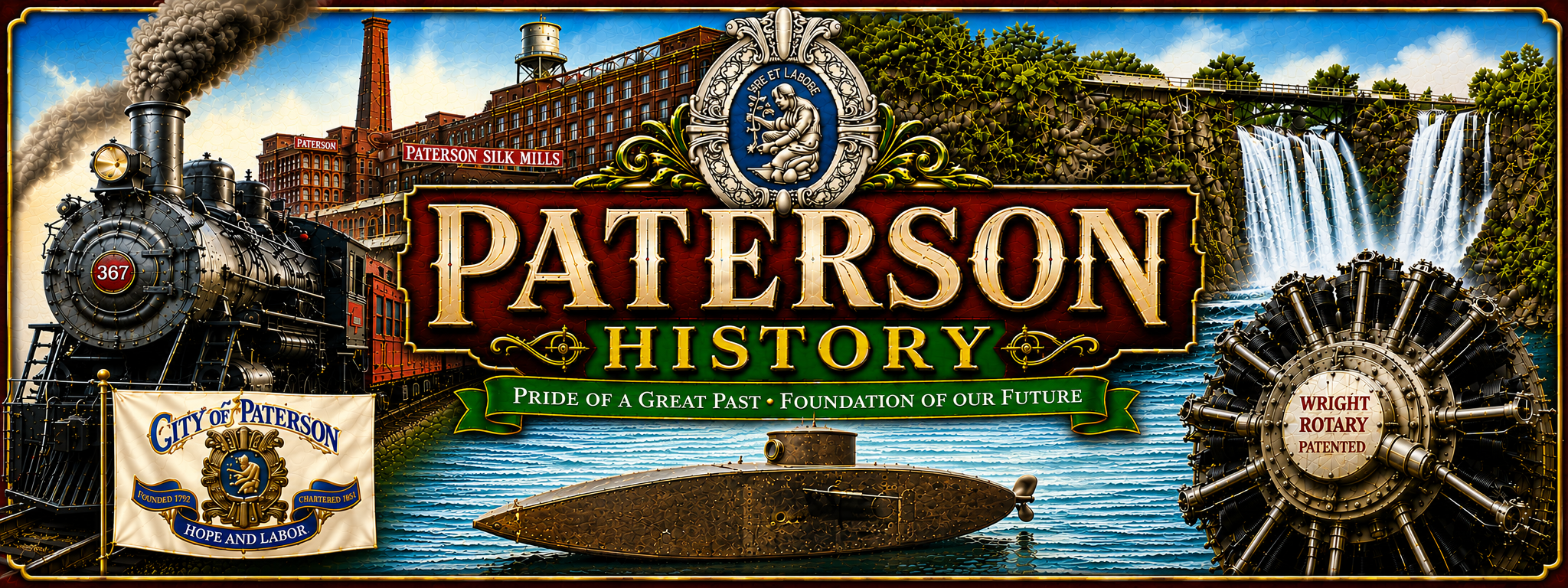


The Grant Locomotive Works was one of the three great locomotive manufacturers that made Paterson, New Jersey, the leading center of steam locomotive production in the United States during the nineteenth century. Along with Rogers Locomotive Works and Cooke Locomotive and Machine Works, Grant produced thousands of locomotives that helped build America’s expanding railroad network and were exported around the world. Between 1867 and 1895, the company built approximately 1,888 steam locomotives before relocating to Chicago, where it ultimately ceased operations.
Early History
The origins of Grant Locomotive Works date to 1842, when Samuel Smith, Abram Collier, and George Bradley established a small iron foundry in Paterson. After several reorganizations, the business became Swinburne, Smith & Company, led in part by William Swinburne, former superintendent of Rogers Locomotive Works.
In 1851, the firm received a charter as the New Jersey Locomotive and Machine Company and leased land from the Society for Establishing Useful Manufactures (S.U.M.) at Market and Spruce Streets, where a three-story factory was erected. The company quickly became known for building quality steam locomotives, often referred to as “Brandt Engines” after superintendent John Brandt.
The Grant Era
Financial difficulties led New York banker Oliver DeForest Grant to acquire control of the company in 1863. Four years later, after receiving a New Jersey corporate charter, the business was reorganized as the Grant Locomotive Works.
Under Grant’s leadership, production increased steadily, and the company became one of the nation’s principal locomotive builders. At its peak, the works employed more than 700 workers and occupied approximately 157,000 square feet in nine major buildings. In 1881 alone, the company completed 110 locomotives.
The Paterson Works
The Grant plant stood along the Morris Canal and the raceways of the Society for Establishing Useful Manufactures near Market and Spruce Streets. The complex included:
- Erecting shops
- Boiler shops
- Machine shops
- Blacksmith shops
- Foundries
- Pattern shops
- Offices
- Storage buildings
Its location provided easy access to water power, rail transportation, and nearby iron suppliers, making it an ideal site for locomotive manufacturing.
Locomotive Production
Grant manufactured a wide variety of steam locomotives, including:
- Passenger locomotives
- Freight locomotives
- Consolidation (2-8-0) locomotives
- Narrow-gauge locomotives
- Industrial locomotives
Its engines served railroads throughout the United States, Canada, Mexico, South America, and Europe. The company became particularly well known for producing locomotives for western railroads during the rapid expansion of rail service after the Civil War.
The Famous Consolidation
Grant played an important role in the history of one of America’s most successful locomotive designs—the 2-8-0 Consolidation.
Although the original Consolidation design was built by Baldwin in 1866, Grant became one of its leading manufacturers. In 1881, when Baldwin was unable to fulfill a large order for the Denver & Rio Grande Railroad, part of the contract was assigned to Grant. One of these locomotives, Denver & Rio Grande No. 223, survives today and is one of only two known surviving Grant-built locomotives.
Challenges
Despite producing excellent locomotives, Grant Locomotive Works struggled financially throughout much of its existence.
Major setbacks included:
- A boilermakers’ strike in 1872
- Cancellation of part of a large Russian locomotive order in 1874
- A devastating fire in 1887 that destroyed roughly half of the Paterson plant
Although the company rebuilt, competition from larger locomotive manufacturers continued to increase.
Move to Chicago
In the early 1890s, Chicago investors persuaded the company to relocate to Illinois, hoping to establish a major locomotive manufacturing center closer to western railroads.
More than $1 million was invested in a modern factory equipped with new machinery. However, the timing proved unfortunate. A labor strike and the Panic of 1893 severely affected production. The company built only 24 locomotives at its Chicago works before entering receivership, effectively ending Grant Locomotive Works as an independent manufacturer.
Legacy
Although Grant Locomotive Works existed for less than three decades under its famous name, it played a vital role in establishing Paterson as one of the world’s premier locomotive-building cities. Together with Rogers and Cooke, Grant helped produce more than 10,000 steam locomotives in Paterson between 1837 and 1926. These engines hauled freight and passengers across North America and around the globe, contributing to the growth of commerce, settlement, and industry during the great railroad age.
Today, the site of the Grant Locomotive Works is recognized as an important part of the Paterson Great Falls National Historical Park and the city’s rich industrial heritage. Historic documentation preserved by the Library of Congress and the National Park Service provides valuable insight into one of Paterson’s most significant nineteenth-century industries.