The 1870 Bridge
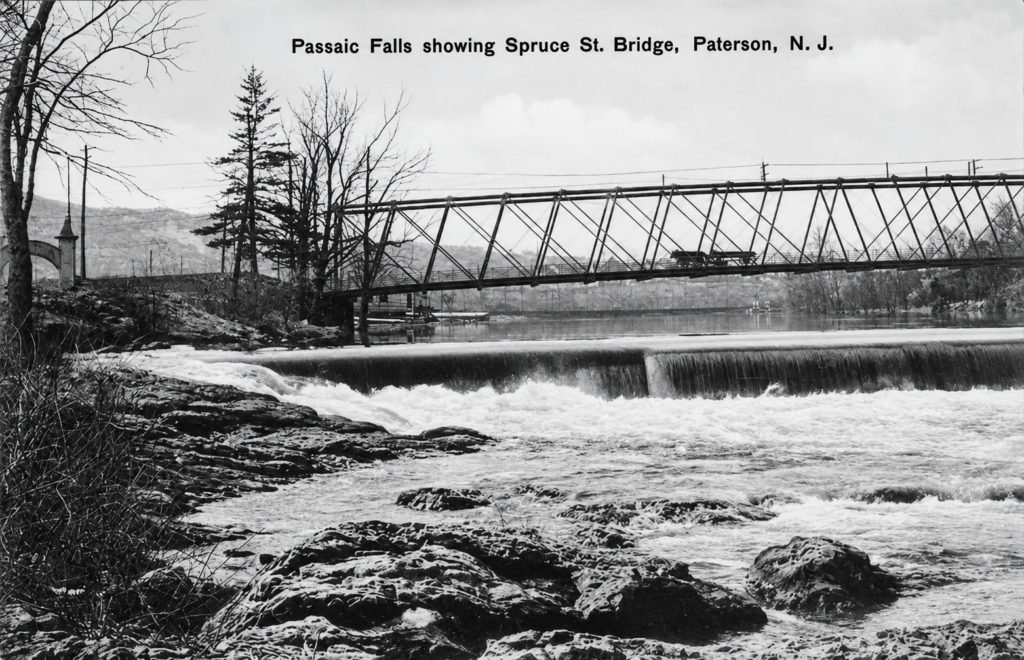
The Spruce Street Bridge is one of the important historic crossings in Paterson, New Jersey, linking the city’s Great Falls district with the community of Totowa across the Passaic River. Located immediately upstream from the Great Falls, the bridge has served generations of residents, workers, motorists, and visitors and has become an important gateway to one of New Jersey’s most significant industrial landscapes.
An Early Crossing
The history of a bridge at this location reaches back well before the present structure. During the middle of the nineteenth century, Totowa was beginning to develop on the north bank of the Passaic River, and a bridge was constructed in this vicinity sometime between approximately 1850 and 1860. This earlier crossing connected Paterson with the developing residential area of Totowa.
The location was particularly important because of its proximity to the Great Falls and the enormous industrial complex created around them. Beginning in the 1790s, the Society for Establishing Useful Manufactures developed a sophisticated system of canals and raceways that diverted water from the Passaic River to power factories. The canal system eventually supplied water power to more than 100 buildings and helped establish Paterson as one of America’s earliest planned industrial cities.
Consequently, a bridge at Spruce Street was more than simply a transportation facility. It connected neighborhoods on opposite sides of the river while providing access to the mills, factories, raceways, and commercial activity surrounding the Great Falls.
The 1931 Bridge
By the early twentieth century, the older crossing was no longer adequate for the rapidly changing transportation needs of Paterson and Totowa. Automobile traffic was increasing, and the bridge had to accommodate substantially greater loads than the nineteenth-century structure had been designed to handle.
A new bridge was constructed in 1931. The new structure connected Spruce Street in Paterson with Wayne Avenue in Totowa, at a location farther downstream than the earlier crossing. It was built as a concrete-and-steel bridge and became an important link between Paterson and Totowa.
The bridge was a five-span structure and carried vehicular traffic as well as sidewalks for pedestrians. Its location immediately adjacent to the Great Falls gave travelers dramatic views of the Passaic River and the surrounding industrial landscape.
Historic photographs and engineering documentation preserved by the Historic American Engineering Record show the 1931 bridge in the context of the old power canal system, including the Middle Raceway and the former industrial buildings surrounding it.
The Bridge and Paterson’s Industrial Heritage
The Spruce Street Bridge occupies an especially significant location in Paterson history. On one side lies the Great Falls and the former Society for Establishing Useful Manufactures power system; nearby were major factories that depended upon the waterpower generated by the falls.
The surrounding area was once filled with textile mills, locomotive works, machine shops, and other industries. The raceways carried water from the Passaic River through the industrial district, turning the natural power of the Great Falls into mechanical energy.
The bridge therefore became a convenient vantage point from which generations of Paterson residents could see the relationship between the river, the falls, the raceways, and the factories that made Paterson famous as the “Silk City.”
The importance of this landscape was formally recognized when the Society for Establishing Useful Manufactures Historic District was placed on the National Register of Historic Places in 1970 and subsequently recognized as a National Historic Landmark.
A Dangerous Moment in 1984
After more than five decades of service, the 1931 bridge had deteriorated significantly.
In February 1984, a portion of the concrete side of the bridge fell into the Passaic River. An inspection revealed that supporting columns had become dislodged, and the approximately 50-year-old bridge was immediately closed. At the time, Mayor Frank X. Graves described the situation as potentially disastrous because of the large volume of traffic using the bridge. A contemporary newspaper account reported that approximately 35,000 vehicles crossed the bridge.
The incident demonstrated the importance of the Spruce Street crossing to the region. Closing the bridge created major transportation problems for people traveling between Paterson and Totowa.
Rehabilitation and Reconstruction
The bridge subsequently underwent major work. State historic documentation identifies 1985 as an important rehabilitation date, and later sources describe the bridge as having undergone reconstruction and rehabilitation while retaining its basic historic location and function.
For many years afterward, the bridge continued to carry heavy traffic between Paterson and Totowa. Its proximity to the Great Falls also made it an important entrance to the historic district and, later, to Paterson Great Falls National Historical Park.
Today, the National Park Service identifies the intersection of Wayne Avenue and Spruce Street as an important approach to the Great Falls area.
The “Gateway to the Falls”
As Paterson’s Great Falls area developed into a major historic and recreational destination, the Spruce Street Bridge took on a new role. It was no longer simply a transportation crossing; it became a gateway to the Great Falls.
The bridge provides an important connection between the urban neighborhoods of Paterson and the Great Falls National Historical Park. Its location gives motorists and pedestrians an immediate sense of the area’s industrial and natural history.
The bridge’s importance was recognized during the extensive improvement project undertaken in the 2010s and early 2020s. The project was intended not only to improve safety but also to enhance the appearance and accessibility of the bridge as an entrance to the Great Falls.
The 2022 Improvements
After years of planning and construction, the Spruce Street Bridge reopened in September 2022 following a major renovation project costing approximately $5.8 million. The work included replacement of the bridge deck, sidewalks, railings, and lighting.
Passaic County’s project documentation describes the bridge as a highly traveled structure and notes its importance as the “Gateway to the Falls.” The improvements included a new high-performance concrete deck, improved pedestrian accessibility, traffic-signal improvements, and changes designed to make the bridge safer while respecting its historic surroundings.
Rather than treating the bridge simply as an aging piece of transportation infrastructure, the project recognized its relationship to Paterson’s historic landscape and to the Great Falls.
A Bridge Connecting Two Communities
For nearly two centuries, bridges in this area have connected Paterson with the communities on the opposite side of the Passaic River. The present Spruce Street crossing is part of that continuing history.
The bridge has witnessed enormous changes in Paterson. When the first crossing was built in the nineteenth century, the area was dominated by water-powered factories and raceways. The 1931 bridge arrived during the age of automobiles and industrial expansion. It survived decades of increasing traffic, deterioration, and changing transportation patterns. Its near-failure in 1984 demonstrated how essential it had become to the community, while the extensive improvements of the twenty-first century ensured that it could continue serving future generations.
Today, the Spruce Street Bridge stands at the meeting point of transportation, industry, engineering, and preservation. Just downstream are the Great Falls of the Passaic River, while the surrounding streets and raceways preserve the remains of the industrial system that helped give birth to Paterson.
The bridge is therefore more than a way across the river. It is part of the historic story of Paterson itself—a physical connection between the city’s industrial past and its continuing future.
Sources
- New Jersey Department of Environmental Protection, Paterson Great Falls State Park / Cultural Resources documentation.
- New Jersey Department of Transportation, New Jersey Historic Bridge Data.
- Historic American Engineering Record, Great Falls/S.U.M. Power Canal System, Paterson, New Jersey.
- Passaic County, Spruce Street Bridge Reconstruction Project.
- CBS New York, report on the 2022 Spruce Street Bridge reopening.
- Marshall Ora Leighton, U.S. Geological Survey, The Passaic Flood of 1903.