Alexander Hamilton’s vision for Paterson began with a simple but revolutionary idea: America’s natural resources could provide the foundation for an independent industrial economy.
In the years following the American Revolution, the United States remained heavily dependent upon European manufactured goods. Hamilton, serving as the nation’s first Secretary of the Treasury, believed that the young republic needed to develop its own manufacturing capacity. In his 1791 Report on the Subject of Manufactures, he argued that manufacturing would strengthen the nation’s economy, create employment, encourage technological development, and reduce dependence on foreign products.
Hamilton saw an extraordinary opportunity at the Great Falls of the Passaic River in northern New Jersey.
The Falls provided something early industrial entrepreneurs desperately needed: reliable mechanical power. Water descending from the Falls possessed enormous energy, and Hamilton believed that this power could be harnessed to operate machinery.
The Society for Establishing Useful Manufactures
To turn the idea into reality, Hamilton helped establish the Society for Establishing Useful Manufactures (S.U.M.). The New Jersey Legislature granted the S.U.M. its charter in November 1791.
The organization was intended to develop an industrial community rather than simply construct a single factory.
The Great Falls became the centerpiece of the plan.
In 1792, the S.U.M. selected the Falls and surrounding area as the site for its manufacturing project. The location offered several advantages:
- abundant waterpower
- a substantial river
- relatively undeveloped land
- access to New York and the growing markets of the Northeast
- proximity to transportation routes
- enough elevation to distribute water through a system of industrial channels
Hamilton’s concept was therefore much larger than a mill beside a waterfall.
He envisioned an industrial city powered by the Passaic River.
Turning Water Into Industrial Power
The key to Hamilton’s plan was to control the water before it reached the Falls.
Instead of allowing all of the water to simply plunge over the Great Falls, engineers would divert a portion of the river into an artificial channel. The water could then be directed to factories constructed at different elevations.
As the water descended, its energy could turn waterwheels and operate machinery.
This was the beginning of what eventually became Paterson’s raceway system.
The concept was remarkably advanced for the 1790s:
Passaic River → Dam → Raceway → Waterwheel → Factory Machinery → Tailrace → River
Rather than treating the Falls merely as a natural attraction, Hamilton saw them as an industrial power source.
Pierre Charles L’Enfant
To translate the concept into an actual industrial landscape, the S.U.M. engaged Pierre Charles L’Enfant, the French-born engineer and designer who would later become famous for laying out Washington, D.C.
L’Enfant surveyed the Great Falls and developed plans for utilizing the waterpower.
His work established the fundamental concept of the raceway system: water would be diverted above the Falls and carried through channels toward industrial sites.
The system could then be expanded as additional factories were built.
More Than a Mill Town
Hamilton’s vision was not simply to create a factory.
He envisioned an industrial community.
Factories would attract workers. Workers would require homes, stores, churches, schools and transportation. Businesses would develop around the manufacturing district.
The industrial development would create a self-sustaining community whose economic foundation was the energy of the Passaic River.
This concept eventually produced the city of Paterson.
The city was named in honor of William Paterson, then Governor of New Jersey and a supporter of the S.U.M.
A New American Industrial Model
Hamilton’s Paterson experiment represented an important departure from the agricultural economy that dominated much of the young United States.
Instead of exporting raw materials and importing finished products, Hamilton wanted America to manufacture its own goods.
Paterson became one of the places where this philosophy could be put into practice.
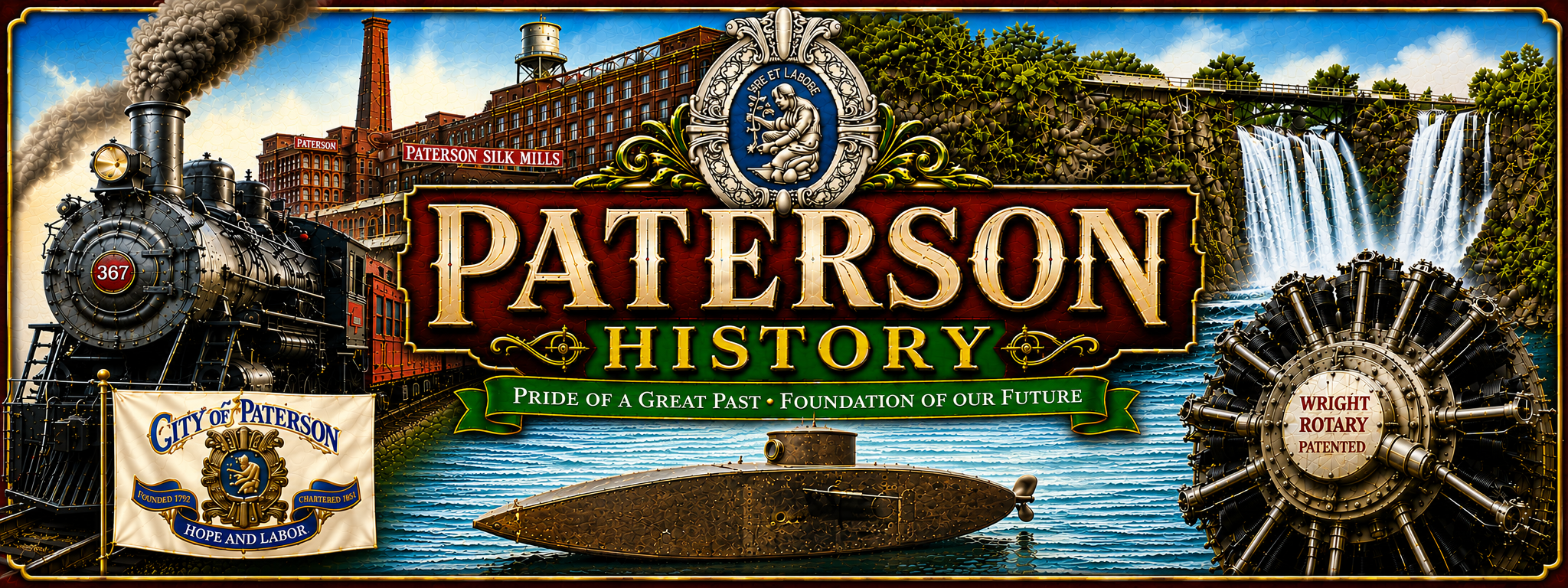
Over the nineteenth century, industries using the raceway system produced cotton textiles, machinery, locomotives, firearms, wire, paper and eventually silk. The city became internationally known for its manufacturing.
The original vision therefore had consequences far beyond the factories immediately surrounding the Falls.
The Beginning of the Industrial City
Hamilton did not live to see Paterson become the great manufacturing center it eventually became. He was killed in his famous duel with Aaron Burr in 1804.
But the basic idea he promoted survived.
The raceways were expanded. More factories were constructed. Engineers improved the waterpower system. Entrepreneurs established new industries. Immigrants arrived to work in the mills and factories.
Over time, the industrial landscape created around the Great Falls became the foundation of modern Paterson.
Hamilton’s vision can therefore be summarized in one sentence:
Harness the power of the Passaic River, use it to manufacture American goods, and build an industrial community around that power.