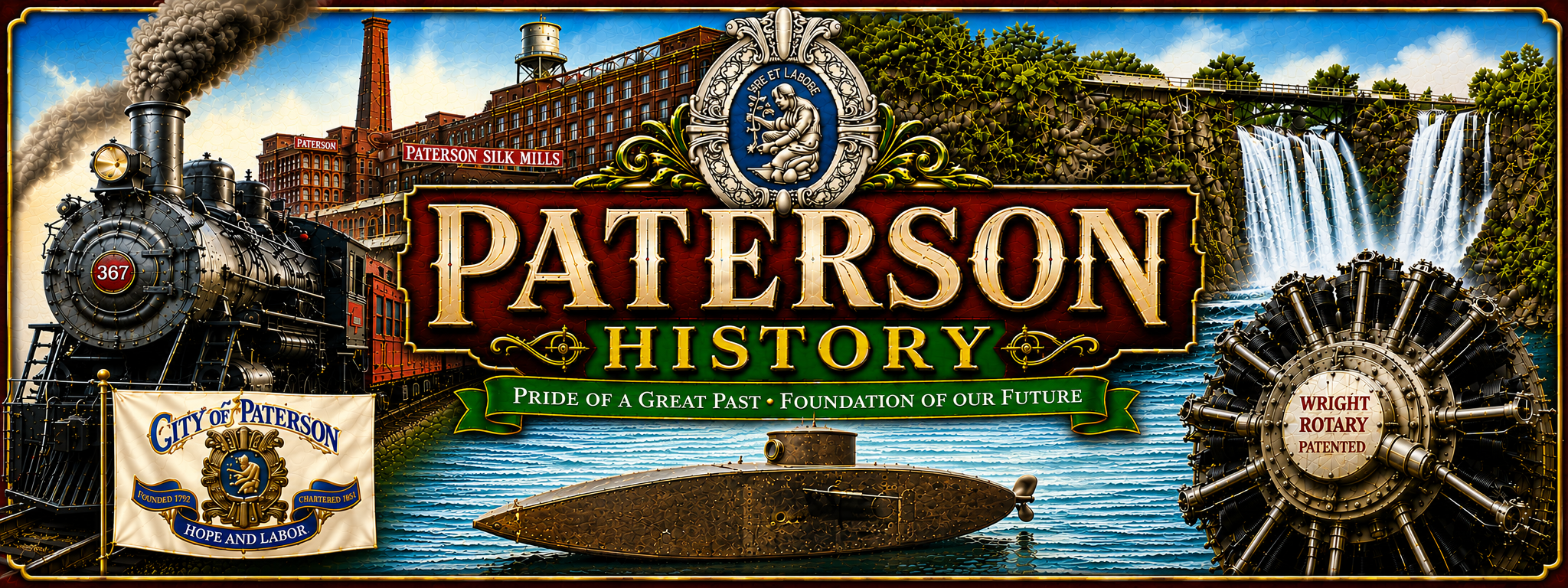
The construction of Paterson’s first raceway in the 1790s marked the beginning of the city’s transformation from a largely undeveloped area around the Great Falls of the Passaic River into one of America’s earliest planned industrial communities.
The raceway was the physical expression of the vision promoted by Alexander Hamilton and the Society for Establishing Useful Manufactures (S.U.M.): the immense power of the Great Falls could be captured, controlled and delivered to factories.
Choosing the Great Falls
In 1791, the New Jersey Legislature chartered the S.U.M. to promote manufacturing in the state. The organization soon focused its attention on the Great Falls of the Passaic River.
The Falls offered an extraordinary natural resource. The river descended approximately 77 feet, creating a substantial amount of potential mechanical energy.
The challenge was how to make that energy available to machinery.
Simply placing a factory beside the Falls would not provide an efficient way to control the water. Engineers needed to divert water from the river above the Falls and carry it through an artificial channel.
That channel became Paterson’s first raceway.
The 1792 Plan
In 1792, the S.U.M. selected the Great Falls as the site of its proposed manufacturing settlement.
Pierre Charles L’Enfant, the French-born engineer and planner, was brought to Paterson to develop plans for the new industrial community.
L’Enfant envisioned a system in which water would be diverted from the Passaic River and directed through a raceway toward manufacturing sites.
The concept was simple:
Passaic River → Diversion → Raceway → Waterwheel → Factory → Tailrace → River
The raceway would provide the controlled flow necessary to operate waterwheels.
Construction Begins
Construction of the first raceway began during the 1790s.
The early system was relatively modest compared with the extensive network that eventually developed, but it established the basic engineering principle upon which Paterson’s industrial economy would depend.
A channel was excavated to carry water from the river toward the developing industrial area.
The S.U.M. also had to construct the associated structures necessary to control the water, including dams, gates and channels.
The project was difficult.
Workers were dealing with uneven terrain, rock, changing water levels and the engineering limitations of the period. The S.U.M. also experienced financial and organizational problems.
Nevertheless, the raceway became operational and provided the foundation for the first manufacturing experiments at the Falls.
The First Factories
The S.U.M. hoped that the availability of waterpower would attract manufacturers to Paterson.
Among the earliest industries was a cotton manufacturing operation.
The purpose of the raceway was not merely to bring water to a factory. Water had to arrive at the correct elevation and with enough force to turn a waterwheel.
The wheel converted the movement of the water into mechanical rotation.
That rotation could then be transmitted through shafts, gears and belts to operate manufacturing machinery.
This represented a remarkable technological transformation:
Falling water → Rotating wheel → Mechanical machinery → Manufactured goods
For the first time, the Great Falls was being incorporated into a coordinated industrial system.
Problems With the Early System
The first raceway did not immediately produce the industrial success that Hamilton and the S.U.M. had envisioned.
The S.U.M. experienced financial difficulties, and its early manufacturing ventures encountered numerous problems.
The organization also discovered that building an industrial community required much more than providing waterpower.
Manufacturers needed:
- capital
- skilled workers
- machinery
- transportation
- markets
- raw materials
- reliable management
The S.U.M. gradually shifted away from directly operating manufacturing enterprises.
Instead, it increasingly concentrated on providing industrial land and waterpower to private manufacturers.
This change ultimately became extremely important to Paterson.
The Raceways Become an Industrial Utility
The S.U.M.’s decision to make waterpower available to independent manufacturers helped establish a business model that would shape Paterson’s development.
Rather than operating every factory itself, the S.U.M. could lease mill sites and provide access to the raceway.
Manufacturers could then establish their own businesses around the available waterpower.
In effect, the S.U.M. was creating one of America’s earliest industrial utility systems.
The raceway was its central infrastructure.
Expansion Begins
The original raceway was only the beginning.
As manufacturers arrived, demand for waterpower increased. The S.U.M. extended and modified the system to serve additional industrial sites.
The original channel eventually became part of a much larger network.
During the following decades, the raceway system developed into three principal levels:
Upper Raceway
Middle Raceway
Lower Raceway
The three-level system allowed the available elevation of the Great Falls to be exploited more efficiently.
Water could be used at one level and then continue downward to another manufacturing district.
The Importance of 1792–1799
The years from 1792 through 1799 therefore represent the foundational period of Paterson’s raceway system.
During this period:
- The S.U.M. established the Great Falls as its industrial center.
- L’Enfant developed plans for utilizing the Falls.
- The first raceway was constructed.
- Waterpower was delivered to manufacturing sites.
- Early factories were established.
- The concept of leasing waterpower to private manufacturers developed.
- The physical foundation for Paterson’s industrial district was created.
The system would be repeatedly expanded and redesigned during the nineteenth century, but the essential concept remained unchanged.
A New Industrial Landscape
The first raceway began a transformation that would change Paterson permanently.
Before the S.U.M.’s arrival, the Great Falls was primarily a spectacular natural feature of the Passaic River.
After the construction of the raceway, the Falls became the power source of an emerging industrial city.
Factories clustered around the water.
Workers followed the factories.
Businesses followed the workers.
Streets and neighborhoods expanded around the industrial district.
Over the next century, Paterson would become known for textiles, silk, locomotives, firearms, machinery and numerous other industries.
All of this industrial development can be traced back to the fundamental engineering decision made in the 1790s:
Divert the Passaic River, control its flow, and turn the Great Falls into usable mechanical power.
The Beginning of the Raceway Era
The first raceway of the 1790s was modest compared with the extensive network that eventually crossed Paterson’s industrial district.
Yet its importance cannot be measured by its size.
It established the principle that would guide Paterson’s industrial development for more than a century:
The power of the Great Falls could be captured, controlled and distributed to industry.
The first raceway was therefore more than a water channel.
It was the beginning of Paterson’s industrial power system—and one of the first physical foundations of the city itself.