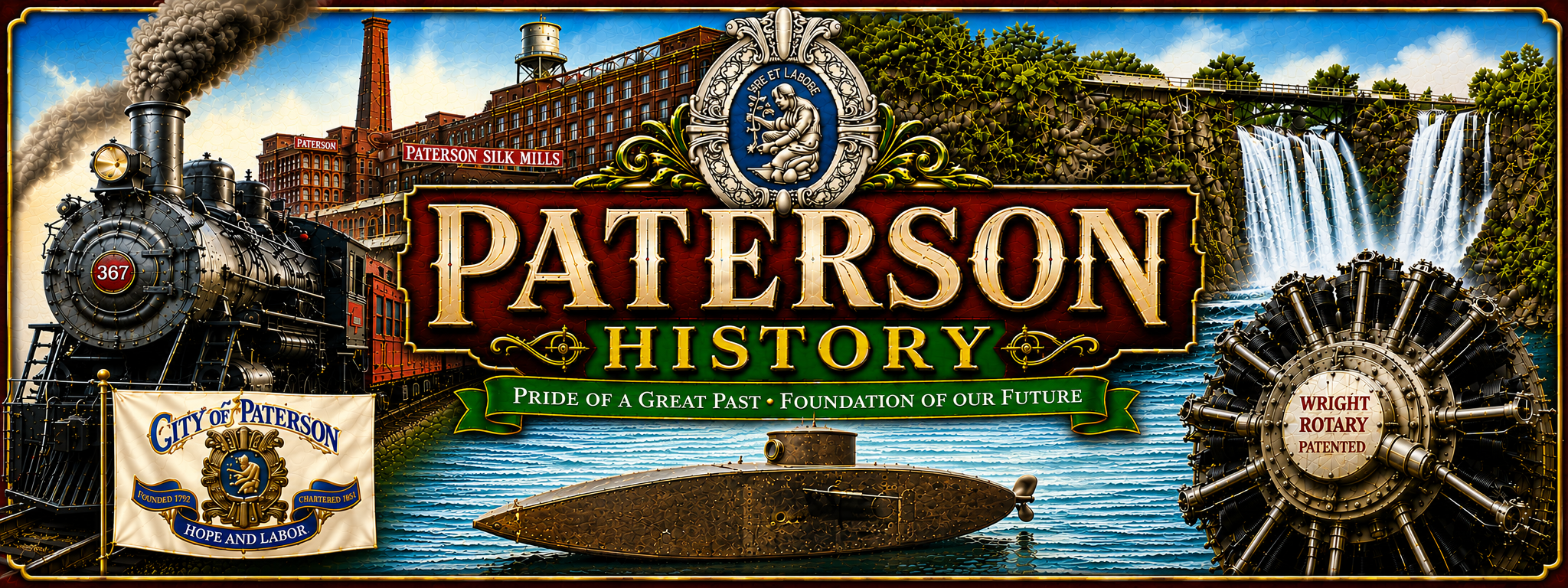
Paterson’s famous locomotive industry grew from the same industrial foundation that had transformed the Great Falls of the Passaic River into a source of mechanical power.
Long before Paterson became known as the “Silk City,” the city had established a reputation for machinery, ironworking and precision manufacturing. The raceway system surrounding the Great Falls helped provide the mechanical power that supported this industrial environment.
The story of Paterson’s locomotives is therefore closely connected to the older story of waterpower, mills and the raceways.
From Waterpower to Heavy Industry
The Society for Establishing Useful Manufactures established Paterson’s industrial foundation in the 1790s.
The raceways provided manufacturers with access to mechanical power.
Initially, much of the manufacturing centered on textiles and other relatively light industries.
But the industrial district gradually developed a much broader manufacturing base.
Paterson became a center for:
- ironworking
- machinery
- firearms
- wire
- textile machinery
- precision manufacturing
- locomotives
The development of these industries created the skilled workforce and manufacturing expertise necessary for locomotive production.
The Rogers Locomotive Works
The most famous locomotive manufacturer in Paterson was the Rogers Locomotive Works.
The company was established in 1832 by Thomas Rogers, initially as a general machine shop.
Rogers became involved in locomotive construction during the 1830s.
The company built its first locomotive, the Sandusky, in 1837.
That locomotive marked the beginning of an extraordinary manufacturing story.
Over the following decades, Rogers Locomotive Works became one of the leading locomotive manufacturers in the United States.
Why Paterson?
Paterson was an unusually suitable location for locomotive manufacturing.
The city already possessed an established industrial infrastructure.
Among its advantages were:
- waterpower from the Great Falls
- raceways and mill sites
- ironworking experience
- machine shops
- skilled mechanics
- access to transportation
- proximity to New York City
- an established manufacturing workforce
The raceways were part of this industrial foundation.
They helped Paterson develop from a textile and general manufacturing center into a city capable of producing extremely complex machinery.
Waterpower and Machine Shops
Locomotive manufacturing required heavy machinery.
Workers had to:
- forge iron
- drill metal
- cut gears
- bore cylinders
- machine wheels
- shape frames
- fabricate boilers
- assemble complex mechanical components
Many of these operations required substantial mechanical power.
During the early period of Paterson’s industrial development, waterpower provided an important source of that mechanical energy.
The raceways supplied the water.
Waterwheels and later turbines converted the water’s energy into rotation.
That rotation could drive machinery in the machine shops.
The Industrial Power System
The relationship can be illustrated simply:
Passaic River
↓
Dam
↓
Raceway
↓
Waterwheel / Turbine
↓
Power Shaft
↓
Machine Tools
↓
Iron & Steel Components
↓
Locomotive Assembly
The raceway did not directly “power” a locomotive.
Instead, it helped power the machines used to manufacture the locomotive.
That distinction is important.
From General Machine Shop to Locomotive Builder
Thomas Rogers began his business as a general machine manufacturer.
This was significant because locomotive manufacturing required exactly the kind of skills that a successful machine shop developed.
A locomotive was essentially a complex collection of mechanical systems:
- boiler
- cylinders
- pistons
- valves
- connecting rods
- wheels
- axles
- frame
- brakes
- drive mechanisms
Manufacturing these components required highly skilled mechanics and precision machinery.
Paterson’s existing industrial base gave Rogers access to both.
Paterson’s Mechanical Expertise
The city’s manufacturing environment became increasingly sophisticated during the nineteenth century.
Companies produced machinery for textile mills and other factories.
The same mechanical knowledge could be applied to locomotive production.
Paterson therefore developed an industrial specialization in complex mechanical manufacturing.
This was one of the reasons the city could compete with other major locomotive-producing centers.
The Raceways and the Industrial District
The raceways also influenced where factories were located.
Factories requiring waterpower tended to cluster along the channels.
This created a dense industrial district around the Great Falls.
Machine shops, foundries, textile factories and other manufacturers operated in close proximity.
The concentration encouraged the exchange of:
- skilled workers
- machinery
- raw materials
- technical knowledge
- suppliers
- manufacturing techniques
This industrial ecosystem helped Paterson’s locomotive industry grow.
Rogers Locomotives Become Famous
Rogers locomotives gained a reputation for quality and durability.
The company produced locomotives for railroads throughout the United States.
Its customers included some of the country’s most important railroads.
Rogers also built locomotives for export.
The locomotives manufactured in Paterson eventually operated on railways across the United States and in other countries.
Thus, machinery manufactured in the shadow of the Great Falls found its way into a rapidly expanding international transportation network.
Locomotives and the Expansion of America
The nineteenth-century railroad revolution created enormous demand for locomotives.
Railroads opened new markets and connected cities that had previously been separated by long distances.
Locomotives carried:
- passengers
- agricultural products
- manufactured goods
- raw materials
- military supplies
Paterson’s locomotive factories therefore became participants in one of the most important technological transformations in American history.
The city was not merely supplying local railroads.
It was helping build the nation’s expanding transportation infrastructure.
Waterpower Gives Way to Steam
There is an interesting irony in Paterson’s locomotive story.
The raceways supplied waterpower to the manufacturing infrastructure that helped produce machines powered by steam.
The locomotive itself used steam generated in its boiler.
Thus:
Waterpower helped manufacture steam-powered locomotives.
As locomotive production expanded, steam power also became increasingly important inside Paterson’s factories.
Steam engines supplemented the raceways and provided greater flexibility.
The Decline of Direct Waterpower
As the nineteenth century progressed, steam engines became increasingly powerful and reliable.
Factories no longer had to depend entirely upon the flow of the Passaic River.
Electricity eventually provided an even greater transformation.
The development of electrical power allowed manufacturers to operate machines almost anywhere.
The raceways consequently declined as a primary source of industrial energy.
Nevertheless, Paterson’s locomotive industry continued to flourish for decades.
The Great Locomotive Manufacturers
Rogers was the best-known Paterson locomotive builder, but it was part of a larger industrial tradition.
Other Paterson companies and machine shops contributed to the city’s reputation as a center of heavy manufacturing.
The city’s expertise extended beyond complete locomotives to the production of:
- engines
- boilers
- machinery
- gears
- wheels
- machine tools
- textile machinery
- metal components
This broader manufacturing base was essential to Paterson’s industrial success.
The Rogers Locomotive Works Complex
The physical remains of the Rogers Locomotive Works are especially important to Paterson’s industrial heritage.
The surviving buildings help demonstrate how locomotive manufacturing was organized.
The complex contained the specialized spaces required for heavy industrial production.
When combined with the surviving raceways and other industrial structures around the Great Falls, these buildings provide a remarkably complete picture of nineteenth-century manufacturing.
A City Built on Mechanical Power
The connection between the raceways and the locomotive industry demonstrates how Paterson’s industrial economy evolved.
The process can be summarized as:
Great Falls
↓
Raceway System
↓
Waterpower
↓
Machine Shops
↓
Skilled Workforce
↓
Advanced Manufacturing
↓
Locomotive Industry
↓
National and International Markets
The raceways were therefore one of the early foundations upon which Paterson’s locomotive industry developed.
The End of the Locomotive Era
Rogers Locomotive Works eventually became part of larger corporate combinations as the locomotive industry changed.
The company ceased locomotive production in Paterson in the early twentieth century.
By then, the city was increasingly dependent upon electricity and other modern forms of industrial power.
The old raceways were no longer essential to the operation of the factories.
The great industrial era surrounding the Falls was beginning to decline.
Preserving the Connection
Today, the connection between the raceways and Paterson’s locomotive industry can still be understood by looking at the surviving historic landscape.
The Great Falls provided the natural energy.
The raceways distributed that energy.
The machine shops used it.
Companies such as Rogers transformed mechanical expertise into sophisticated machinery.
And the locomotives built in Paterson helped propel America’s railroad expansion.
The story therefore extends far beyond the raceways themselves.
The Legacy of Waterpower and Locomotives
Paterson’s locomotive industry demonstrates the remarkable evolution of American manufacturing.
The city began with a waterfall.
Engineers transformed the waterfall into a system of raceways.
The raceways powered mills and machine shops.
The machine shops developed increasingly sophisticated manufacturing skills.
Those skills helped Paterson become a major locomotive-producing center.
And the locomotives built in Paterson carried America’s industrial revolution across the continent.
The Great Falls supplied the power.
The raceways distributed it.
The machine shops transformed it into mechanical capability.
Rogers and other manufacturers transformed that capability into locomotives.
And those locomotives helped connect a growing nation.
The raceways were therefore an important part of the long technological chain that connected the Passaic River to the railroad revolution.