Introduction
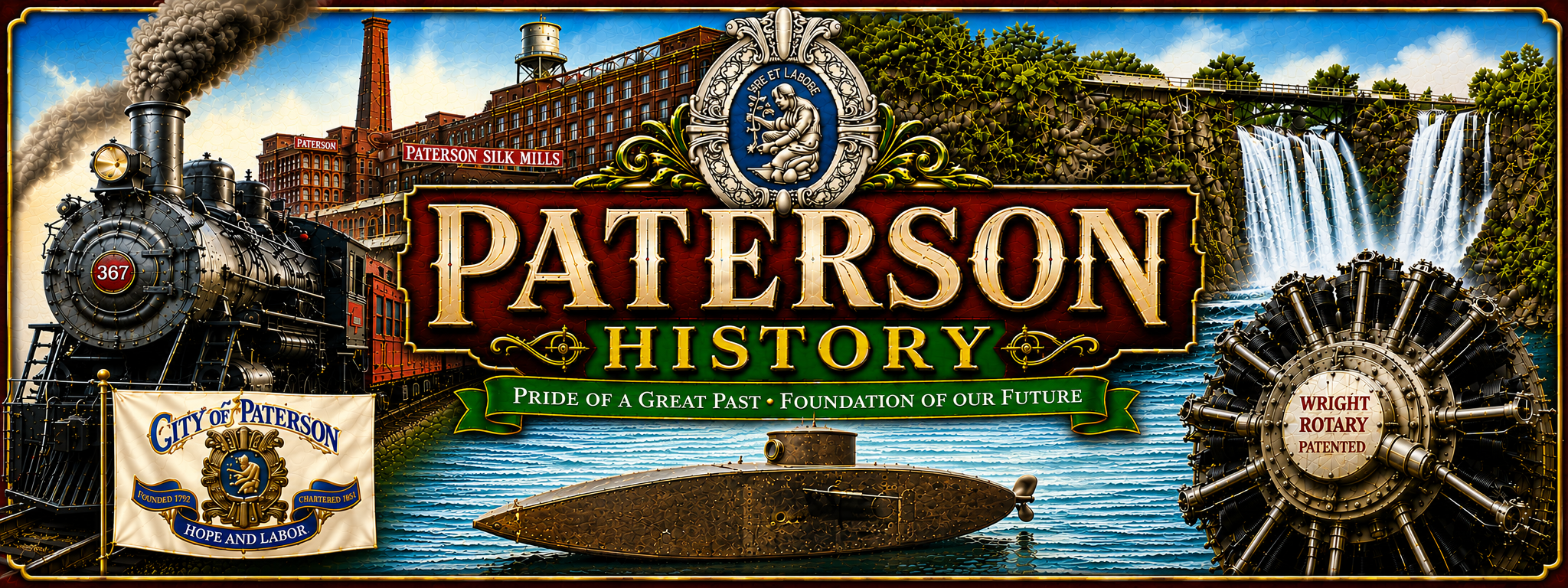
Paterson, New Jersey, has been a center of American labor history for nearly two centuries. The city’s location on the Great Falls of the Passaic River made it one of the nation’s earliest planned industrial communities. Waterpower attracted textile manufacturers, machine shops, locomotive builders, firearms manufacturers, and eventually silk mills and aircraft-engine production.
The prosperity created by Paterson’s factories, however, was accompanied by difficult working conditions. Long hours, low wages, dangerous machinery, child labor, speed-ups, and the growing use of machinery to increase production produced repeated conflicts between workers and employers.
Paterson workers responded by organizing. Sometimes they formed craft unions; at other times they joined broad industrial organizations such as the Industrial Workers of the World (IWW), the American Federation of Labor (AFL), and later the Congress of Industrial Organizations (CIO). These organizations represented different philosophies, but all became part of Paterson’s long struggle over the relationship between labor and management.
1. The Beginning: Paterson’s Early Factory Workers
Paterson’s industrial history began in the 1790s when the Society for Establishing Useful Manufactures selected the Great Falls as the foundation for an industrial community. The Falls provided an enormous source of waterpower.
By the nineteenth century, Paterson had become a major manufacturing center. Textile mills were joined by machine shops, locomotive works, firearms factories, and other industries.
The early factory system created a new kind of worker: someone whose work was controlled by the clock, the factory owner, and the machinery rather than by the traditional craftsman’s independent schedule.
Workers were expected to work extremely long hours.
This created some of Paterson’s earliest labor organizations and protests.
2. The “Baby Strike” of 1835
One of the most important early events in Paterson labor history occurred in 1835.
More than 2,000 workers, many of them women and children, participated in a strike involving workers from approximately twenty textile mills. They sought a shorter working day and protested other factory practices.
The workers were attempting to reduce a working schedule that could extend to thirteen hours or more per day.
The strike did not achieve all of its demands, but the employers ultimately reduced the work schedule somewhat. The action demonstrated something important: Paterson factory workers could organize across individual mills and occupations.
The 1835 strike is therefore an important early chapter in the history of American organized labor. The National Park Service identifies the action as one of the nation’s early industrial strikes.
The significance went beyond the immediate reduction in hours. Paterson workers had discovered that collective action could force employers to respond.
3. The Growth of the Silk Industry
During the second half of the nineteenth century, silk became Paterson’s dominant industry.
By the late nineteenth and early twentieth centuries, Paterson was internationally known as the “Silk City.” Thousands of workers were employed in silk mills, dye houses, ribbon factories, and related businesses.
By 1900, Paterson had approximately 175 silk mills employing more than 20,000 workers.
The silk industry also transformed the city’s population.
Workers came from many parts of Europe, including:
- Italy
- Germany
- Ireland
- Poland
- Russia and Eastern Europe
- Austria-Hungary
- other European countries
Women played an important role in the silk industry, as did children and young workers.
The workforce was therefore ethnically diverse, multilingual, and divided by skill, occupation, religion, and nationality.
Those divisions sometimes made organizing difficult. Employers could take advantage of differences between groups, while workers increasingly discovered that collective action could unite people who otherwise had little contact with one another.
4. Labor Unions Before the Great Strike
Labor organizing expanded during the late nineteenth century.
Skilled workers organized unions representing particular trades, including weavers, dyers, machinists, molders, and other occupations.
The American Federation of Labor, founded in 1886, encouraged craft unionism, concentrating on wages, working hours, working conditions, and recognition of individual trades.
Paterson experienced numerous strikes during this period.
Between 1881 and 1900, dozens of strikes occurred in the city’s silk industry, most commonly involving wages and working hours.
The strikes demonstrated that labor unrest was not something that suddenly appeared in 1913. The famous Silk Strike was the culmination of decades of organizing, disputes, and unsuccessful attempts by workers to gain greater control over their working lives.
5. The Four-Loom System
By the beginning of the twentieth century, Paterson’s silk manufacturers were searching for ways to increase production.
One of the most controversial changes was the introduction of the four-loom system.
Traditionally, a silk weaver might operate two looms. The new system required workers to tend four.
Workers feared that the change would:
- increase their workload;
- reduce employment;
- lower wages;
- undermine skilled craftsmanship;
- increase production without proportionally increasing pay.
The issue had already produced disputes before 1913.
At the Doherty Silk Mill, workers had previously resisted attempts to introduce the four-loom system.
The dispute would eventually become the immediate spark for Paterson’s greatest labor conflict.
6. The Great Paterson Silk Strike of 1913
The Great Paterson Silk Strike began in early 1913.
The immediate dispute involved the four-loom system, but the underlying grievances were much broader.
Workers demanded:
- an eight-hour day;
- higher wages;
- improved working conditions;
- changes to the loom system;
- protection of skilled work;
- greater respect for workers’ rights.
The strike quickly spread throughout the city’s silk industry.
By the end of February, approximately 24,000 workers had joined the industry-wide strike and nearly 300 mills and dye houses were closed.
Paterson had effectively become a citywide labor battleground.
7. The Industrial Workers of the World
The Industrial Workers of the World, commonly known as the IWW or “Wobblies,” became closely associated with the 1913 strike.
The IWW differed from traditional craft unions because it attempted to organize workers across skill levels and occupations into one industrial organization.
Among the best-known IWW figures associated with Paterson were:
- William “Big Bill” Haywood
- Elizabeth Gurley Flynn
- Carlo Tresca
- Patrick Quinlan
- Adolph Lessig
- Ewald Koettgen
It is important, however, to distinguish between the workers who initiated the strike and the later involvement of the IWW.
Rutgers University notes that the IWW did not actually start the Paterson strike. Local workers had already organized the dispute and invited IWW leaders to assist as speakers and advisers.
The IWW nevertheless became one of the most important forces associated with the strike.
8. Women in Paterson’s Labor Movement
Women were central to Paterson’s labor history.
Women worked in the silk mills and participated in picketing, meetings, demonstrations, relief activities, and organizing.
Elizabeth Gurley Flynn became one of the best-known speakers associated with the strike.
Women also organized meetings specifically for female workers.
The participation of women challenged the idea that labor organizing was primarily a male activity.
The 1913 strike demonstrated that women could be organizers, speakers, picketers, and leaders in a major industrial conflict.
9. Immigration and Labor Solidarity
Perhaps the most remarkable aspect of the 1913 strike was its ability to bring together workers from many different ethnic communities.
Paterson’s silk workforce included people who spoke different languages and came from very different European backgrounds.
The strike forced these workers to cooperate around common economic demands.
The National Park Service describes the IWW’s role in helping unite different craft and ethnic groups through a central strike committee.
This was one of the great experiments in industrial democracy in early twentieth-century America.
For several months, the traditional divisions between skilled and unskilled workers, Italians and Germans, men and women, and different immigrant communities were partially overcome by a common cause.
10. The Botto House and Haledon
Because Paterson authorities restricted public meetings and picketing, the neighboring community of Haledon became an important center of the strike.
The home of Pietro and Maria Botto became famous as a gathering place for striking workers.
From the home’s second-floor balcony, labor leaders addressed enormous crowds.
Thousands of workers and their families gathered there on Sundays.
The Botto House eventually became the American Labor Museum, preserving one of the most important sites associated with American labor history.
The National Park Service recognizes the Botto House as a National Historic Landmark because of its role during the 1913 strike.
11. Arrests and Conflict
The strike produced an intense confrontation between workers and the city’s established institutions.
Employers, government officials, police, courts, and much of the business community opposed the strike.
Workers responded with mass picketing and demonstrations.
More than 2,000 strikers were arrested during the conflict, many for disorderly conduct and related offenses.
The use of arrests and restrictions on meetings demonstrated how limited workers’ legal protections were in 1913.
Collective bargaining rights and federal labor protections that Americans take for granted today did not yet exist in their modern form.
12. The Paterson Strike Pageant
The strike eventually became a national cause.
To raise money and public awareness, supporters organized the Paterson Strike Pageant at Madison Square Garden in New York City on June 7, 1913.
Actual Paterson strikers participated in a dramatic reenactment of their struggle.
The event demonstrated how Paterson’s labor conflict had become nationally significant.
The strike was no longer simply a dispute between Paterson silk workers and local manufacturers. It had become part of a national debate about industrial capitalism, workers’ rights, immigration, poverty, and the future of organized labor.
13. The End of the 1913 Strike
After approximately five months, the strike ended without achieving the workers’ principal objectives.
The manufacturers had successfully resisted union recognition and the major changes demanded by the strikers.
Many workers suffered financially, and some were blacklisted.
The strike therefore represented an immediate defeat for the workers.
But its historical significance was much larger.
The strike demonstrated the power of mass industrial organization and brought national attention to Paterson.
It also helped make the eight-hour day, improved working conditions, industrial democracy, and collective bargaining important subjects of national discussion.
14. Labor Organizing Between 1913 and 1925
The defeat of 1913 did not end labor organizing in Paterson.
Workers continued to organize and strike.
The silk industry remained a major employer, although its position gradually weakened.
The national textile industry increasingly faced competition from Southern factories and other locations where production costs were lower.
Paterson’s workers also faced technological changes that altered traditional skilled occupations.
The result was a continuing struggle over wages, hours, job security, and the survival of the city’s industrial base.
15. The Paterson Labor Movement and the 1926 Strikes
The year 1926 brought another important period of labor activity.
Paterson silk workers organized a campaign for a shorter workweek.
The Associated Silk Workers, with support from the United Textile Workers, sought an eight-hour day and a 44-hour workweek.
Unlike the dramatic confrontation of 1913, much of the Paterson campaign was accomplished through the threat of a general walkout.
Many manufacturers accepted the shorter schedule rather than risk a citywide strike.
At the same time, Paterson workers became involved in the much larger Passaic Textile Strike of 1926, which involved woolen workers in neighboring Passaic and surrounding communities.
Paterson labor organizations helped provide relief and support for striking families.
The events demonstrated that the labor movement had survived the defeat of 1913.
16. The Decline of the Silk Industry
During the 1920s and 1930s, Paterson’s silk industry entered a prolonged decline.
Factories increasingly moved production to other regions.
The industry faced competition from:
- Southern textile mills;
- lower labor costs elsewhere;
- technological changes;
- synthetic fibers;
- changing consumer demand;
- the Great Depression.
A federal study of Paterson’s silk workers later described the industry’s decline and the resulting instability of employment.
For workers, the problem was changing from simply “How much should we be paid?” to “Will this job still exist?”
That distinction would become increasingly important in Paterson labor history.
17. The Rise of Industrial Unionism
The 1930s brought a major transformation to American labor.
The passage of the National Labor Relations Act of 1935, commonly called the Wagner Act, gave workers a federally protected right to organize and bargain collectively.
The creation of the Congress of Industrial Organizations (CIO) brought a new approach to union organizing.
Instead of organizing workers strictly according to individual crafts, CIO unions attempted to organize entire industrial workplaces.
This approach was particularly important in cities such as Paterson, where large factories employed workers in many different occupations.
18. Wright Aeronautical and a New Generation of Paterson Workers
As the silk industry declined, other industries became increasingly important.
One of the most significant was Wright Aeronautical Corporation.
The company became one of the major employers in the Paterson area and produced aircraft engines.
During World War II, production expanded dramatically.
Women entered the industrial workforce in large numbers. In August 1943, approximately 10,912 women were employed across seven Wright Aeronautical plants in the area.
This created a new generation of industrial workers and brought a different form of labor organization to Paterson.
19. The UAW Comes to Paterson
Wright Aeronautical workers became represented by the United Automobile Workers (UAW), affiliated with the CIO.
The UAW organized workers in the aircraft industry despite the fact that aircraft manufacturing was very different from automobile production.
Labor-management disputes at Wright became major events.
In 1945, for example, a strike involving Wright Aeronautical plants in Paterson, East Paterson, Fair Lawn, and Wood-Ridge involved approximately 24,000 workers. The federal Bureau of Labor Statistics recorded the union as the UAW-CIO and identified the discharge of a union steward as the principal issue.
This was one of the largest industrial work stoppages connected with Paterson during the twentieth century.
The episode demonstrated how dramatically Paterson’s labor movement had changed since 1913.
The silk weaver’s union had been replaced by industrial unions representing thousands of workers in modern manufacturing.
20. African American Workers and Organized Labor
Labor history in Paterson must also include the experiences of African American workers.
African Americans had lived in Paterson since the city’s earliest years, but discrimination restricted employment opportunities in many industries.
During World War II, labor shortages opened additional industrial jobs to African Americans.
The federal government attempted to combat racial discrimination in defense industries through Executive Order 8802, while unions and civil-rights organizations also fought discriminatory employment practices.
Yet discrimination did not disappear.
The Library of Congress’s oral-history collection on Paterson records the experiences of African American workers who encountered occupational segregation.
One worker at Wright Aeronautical recalled that Black employees were restricted to lower-level work until civil-rights changes opened higher-paying technical positions.
Thus, the history of labor organizing in Paterson is also a history of the struggle for racial equality in employment.
21. Women and the Wartime Workforce
World War II dramatically changed Paterson’s workforce.
Thousands of women entered factories because men were serving in the armed forces.
At Wright Aeronautical, women worked directly in aircraft production.
They operated machinery, performed assembly work, handled precision manufacturing tasks, and supported the massive wartime production effort.
This expanded the definition of who could be an industrial worker.
The wartime experience also strengthened the position of unions because collective bargaining became an important mechanism for resolving disputes during an era of enormous industrial production.
22. Postwar Paterson
After World War II, Paterson remained an important manufacturing center.
Textiles and apparel continued to employ large numbers of workers, while aircraft manufacturing, machinery, metalworking, and other industries contributed to the local economy.
But the fundamental economic structure was changing.
The textile industry continued to lose jobs.
Between 1950 and 1970, employment in Paterson’s textile industry declined from approximately 14,384 workers to 5,887.
The decline affected not only individual workers but entire neighborhoods.
Factories had supported:
- family incomes;
- neighborhood businesses;
- restaurants;
- taverns;
- churches;
- social organizations;
- ethnic associations;
- transportation;
- local tax revenues.
When factories closed, the effects spread throughout the community.
23. The 1950s and 1960s
The labor movement continued to operate in Paterson during the postwar decades.
At Wright Aeronautical, the UAW remained an important representative of workers.
A 1965 federal appeals court case records the UAW’s representation of salaried office, clerical, and engineering employees at Wright’s facilities in the Paterson-Wood-Ridge area. The union had represented a bargaining unit numbering several thousand employees.
The period also saw continuing disputes over wages, job classifications, seniority, layoffs, and the boundaries of union representation.
At the same time, Paterson’s manufacturing economy was becoming less secure.
24. Deindustrialization
Beginning in the postwar decades and accelerating during the latter twentieth century, Paterson experienced deindustrialization.
Factories closed or moved.
Manufacturing jobs disappeared.
Textile production moved increasingly to the American South and eventually overseas.
Apparel manufacturing also faced growing foreign competition.
The result was a fundamental transformation of Paterson.
A city that had once depended upon thousands of factory workers increasingly became dependent upon service industries, government employment, education, health care, retail businesses, transportation, and small enterprises.
The decline of industrial employment also meant a decline in the influence of traditional industrial unions.
25. Labor Organizing Beyond the Factories
Although the great factories disappeared, labor organizing did not disappear from Paterson.
Union activity continued among:
- public employees;
- teachers;
- municipal workers;
- hospital employees;
- transportation workers;
- service employees;
- building trades;
- postal workers;
- remaining manufacturing workers.
The center of labor activism gradually shifted from the factory floor to public institutions, schools, hospitals, government offices, and service-sector workplaces.
This represented a major transformation in the city’s labor history.
26. The Paterson Public Schools and Organized Labor
Public education became one of the city’s major employers.
Teachers, custodians, clerical employees, maintenance workers, and other school employees became part of the modern public-sector labor movement.
Unlike the silk workers of 1913, public employees operated under a different legal framework.
New Jersey eventually established collective-bargaining rights for public employees through the New Jersey Employer-Employee Relations Act of 1968, commonly known as Chapter 123.
This helped create the modern public-sector labor environment in which teachers and municipal employees could negotiate contracts concerning:
- salaries;
- health benefits;
- working hours;
- pensions;
- working conditions;
- grievance procedures.
27. Labor and the Civil Rights Movement
Paterson’s labor history cannot be separated from its civil-rights history.
During the twentieth century, African American workers increasingly challenged discrimination in employment and unions.
The broader civil-rights movement also changed the meaning of workplace equality.
Equal opportunity became an increasingly important part of labor organizing.
In Paterson, the struggle for better wages and working conditions increasingly overlapped with struggles against racial discrimination and unequal access to employment.
28. The Legacy of the Paterson Labor Movement
Paterson’s labor history is not simply a story of strikes.
It is a story of how ordinary workers attempted to gain a voice in an industrial economy.
The history includes:
1835
The “Baby Strike” demonstrates the ability of factory workers—including children—to organize around working hours.
Late 1800s
Craft unions and repeated silk-industry strikes become common.
1913
The Great Paterson Silk Strike brings approximately 24,000 workers into one of the nation’s most famous industrial conflicts.
1926
Paterson silk workers campaign for a shorter workweek while supporting the neighboring Passaic textile strike.
1930s
The New Deal and Wagner Act transform the legal environment for organized labor.
1940s
CIO industrial unionism and the UAW become important in Paterson’s aircraft industry.
World War II
Women and African Americans enter Paterson’s defense industries in much larger numbers.
1950s–1970s
Textile employment declines dramatically while industrial unions continue to represent workers in manufacturing and other industries.
Late twentieth century
Deindustrialization reduces the number of traditional factory jobs.
Twenty-first century
Labor organizing continues primarily through public-sector, service, educational, health-care, building-trade, and other forms of employment.
Conclusion
The history of labor organizing in Paterson is one of the most important parts of the city’s history.
Paterson was not merely a place where famous strikes occurred. It was a city where generations of working people experimented with different ways of organizing themselves.
The workers of 1835 challenged the thirteen-hour workday.
The silk workers of the late nineteenth century organized against wage cuts and long hours.
The workers of 1913 attempted to unite thousands of people from different nationalities and occupations.
The workers of the 1920s continued the struggle for shorter hours and better conditions.
The industrial workers of the CIO era created powerful unions in factories such as Wright Aeronautical.
African American workers challenged racial barriers.
Women entered industrial employment in unprecedented numbers.
Public employees later became an increasingly important part of the organized labor movement.
The story therefore extends far beyond the famous 1913 Silk Strike.
Paterson’s labor history is ultimately the history of working people attempting to gain a voice, security, dignity, and a fair share of the prosperity they helped create.
The Great Falls powered Paterson’s factories, but it was the city’s workers who operated the looms, machines, locomotives, aircraft-engine equipment, and thousands of other tools of production.
Their organizing helped shape not only Paterson but the broader history of American labor.