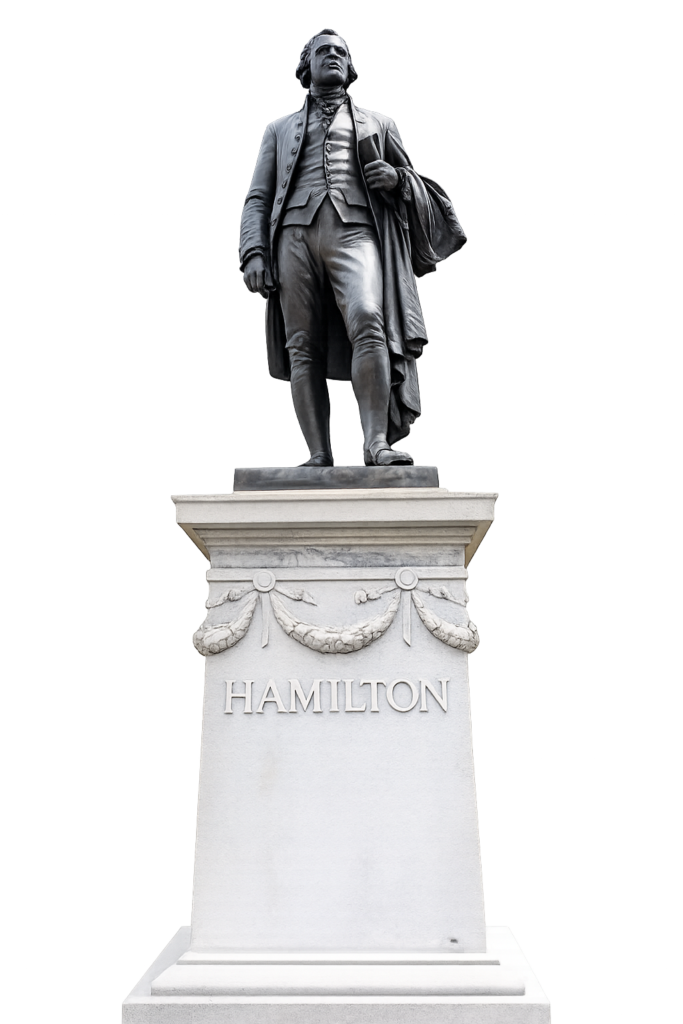
Alexander Hamilton’s Statue
in the Great Falls National Park
Few individuals have had a greater influence on the founding and early development of Paterson, New Jersey, than Alexander Hamilton. Although he never lived in the city that bears Governor William Paterson’s name, Hamilton was the visionary who conceived Paterson as America’s first planned industrial city. His bold ideas laid the foundation for the city’s rise as one of the nation’s greatest manufacturing centers and earned him the title “Father of American Industry.”
Hamilton’s Vision for American Industry
Following the American Revolution, the United States remained largely dependent on Great Britain for manufactured goods. As the nation’s first Secretary of the Treasury under President George Washington, Alexander Hamilton believed that true independence required a strong domestic manufacturing economy.
In his famous Report on Manufactures, submitted to Congress in December 1791, Hamilton argued that the United States should encourage industry, develop manufacturing, and reduce its reliance on foreign imports. He envisioned a nation whose economic strength would rest not only on agriculture but also on factories, skilled labor, and technological innovation.
To bring this vision to life, Hamilton sought a location with an abundant and dependable source of waterpower. He found it at the Great Falls of the Passaic River, one of the largest waterfalls in the eastern United States.
The Society for Establishing Useful Manufactures
In November 1791, Hamilton organized the Society for Establishing Useful Manufactures (S.U.M.), one of the first private-public industrial development corporations in American history. Chartered by the State of New Jersey, the Society was created to finance and promote manufacturing enterprises throughout the new nation.
The Great Falls offered an ideal location. The river’s dramatic 77-foot drop could generate tremendous mechanical power, making it possible to operate factories without relying on wind or animal labor.
Hamilton envisioned an entirely new kind of community—one where canals would distribute waterpower directly to factories, creating a planned industrial city unlike any that had existed before in the United States.
Why Paterson?
Hamilton selected the site because of several advantages:
- The immense waterpower of the Great Falls.
- Proximity to the ports of New York and Newark.
- Access to major transportation routes.
- Availability of undeveloped land.
- Opportunities for future industrial expansion.
The new city was named Paterson in honor of William Paterson, New Jersey’s governor, signer of the U.S. Constitution, and supporter of Hamilton’s industrial plans.
Pierre Charles L’Enfant and the Raceway System
To transform Hamilton’s vision into reality, the Society hired Pierre Charles L’Enfant, the French-born engineer who had designed the plan for the new federal capital, Washington, D.C.
L’Enfant designed an innovative raceway system that diverted water from the Great Falls through a network of canals. The flowing water powered factories before returning to the Passaic River downstream.
Although L’Enfant’s ambitious plans eventually led to disagreements with the Society, his engineering concepts formed the basis of Paterson’s remarkable industrial infrastructure.
America’s First Planned Industrial City
Construction began in 1792.
Unlike most American cities, which developed gradually around existing settlements, Paterson was carefully planned from its inception as an industrial center. Streets, factories, canals, and mill sites were laid out according to a comprehensive plan designed to maximize the use of waterpower.
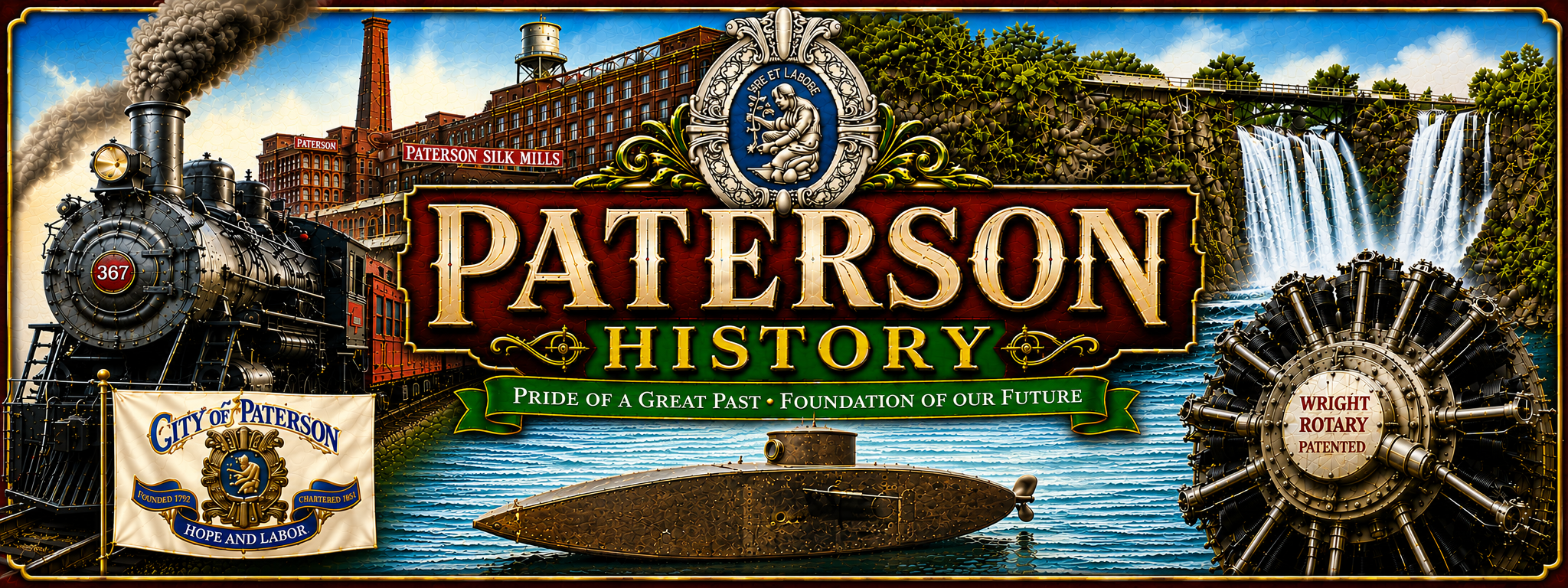
The first cotton mill opened in 1794, marking the beginning of more than a century of industrial growth.
Hamilton’s Legacy
Hamilton did not live to see Paterson fulfill his vision. He was killed in a duel with Vice President Aaron Burr on July 11, 1804.
Nevertheless, the city he helped create grew into one of the world’s leading manufacturing centers. Throughout the nineteenth century, Paterson became internationally recognized for producing:
- Silk textiles
- Steam locomotives
- Firearms
- Machine tools
- Aircraft engines
- Industrial machinery
By the late 1800s, Paterson had earned the nickname “Silk City,” producing more silk than any other city in the United States.
Hamilton’s Lasting Influence
Nearly every major chapter of Paterson’s history can be traced back to Hamilton’s original vision.
His belief that American prosperity depended upon manufacturing shaped not only Paterson but also the nation’s industrial development. The raceway system he conceived continued powering factories for nearly two centuries, while the city’s industries contributed significantly to America’s economic growth, transportation, technological innovation, and national defense.
Today, the Great Falls Historic District and the raceway system remain enduring reminders of Hamilton’s foresight and ambition.
Paterson Great Falls National Historical Park
In 2009, Congress established the Paterson Great Falls National Historical Park, recognizing the national significance of Hamilton’s industrial experiment.
The park preserves:
- The Great Falls of the Passaic River
- The historic raceway system
- Early mill sites
- The remains of the Society for Establishing Useful Manufactures
- The industrial landscape that fulfilled Hamilton’s vision
Visitors can still see many of the engineering features first conceived more than 230 years ago.
Alexander Hamilton’s Legacy in Paterson
Today, Alexander Hamilton is remembered not simply as a Founding Father or the nation’s first Secretary of the Treasury, but as the visionary whose economic philosophy transformed an undeveloped stretch of the Passaic River into America’s first planned industrial city.
Paterson stands as one of Hamilton’s greatest achievements. The city’s mills, raceways, factories, and industries demonstrated that the United States could compete with the world’s leading manufacturing nations. More than two centuries later, Hamilton’s vision continues to define Paterson’s identity and secure its place in American history.