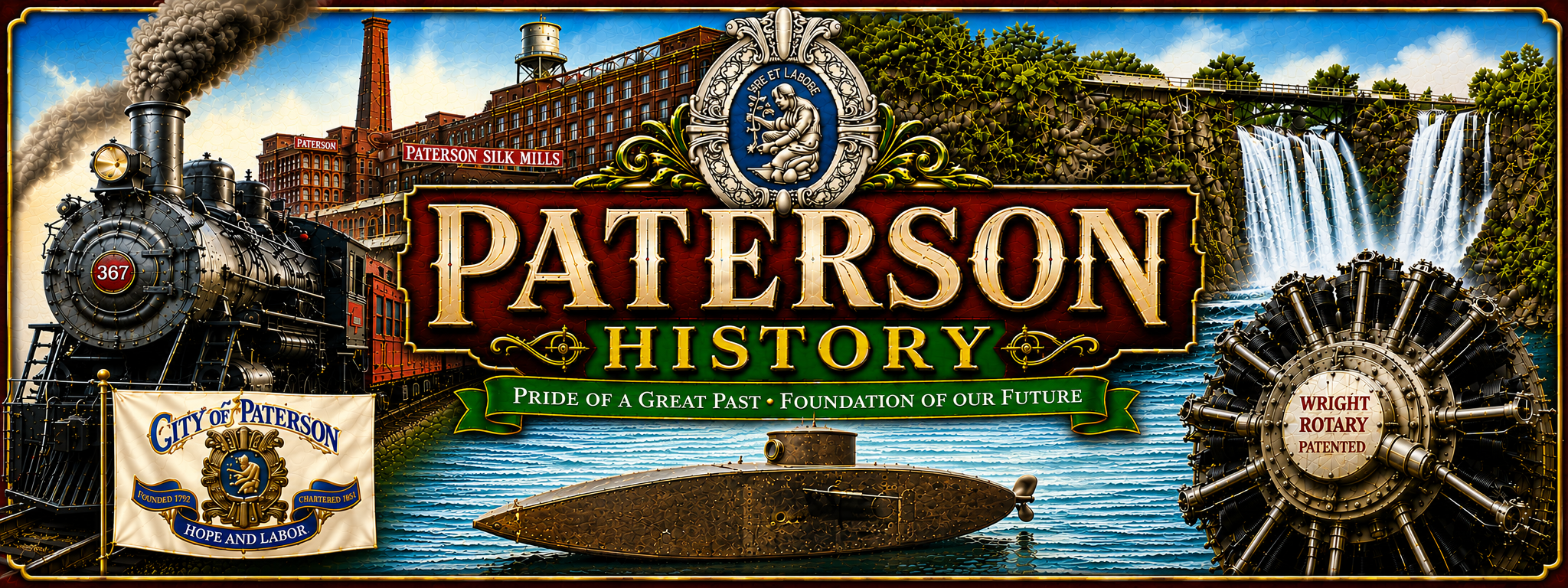


The Cooke Locomotive and Machine Works was one of the most important industrial enterprises in the history of Paterson, New Jersey. Along with the Rogers and Grant locomotive works, it helped establish Paterson as one of the world’s leading centers for the manufacture of steam locomotives during the nineteenth century. Between 1852 and 1901, the company built approximately 2,600 steam locomotives for railroads throughout the United States and around the world before becoming part of the American Locomotive Company (ALCO).
Origins
The company was founded in 1852 as Danforth, Cooke & Company by machinist Charles Danforth and John Cooke, who had previously served as superintendent of the Rogers Locomotive Works. Initially, the firm manufactured both cotton mill machinery and steam locomotives, reflecting Paterson’s diverse industrial economy.
In 1865, the business became the Danforth Locomotive and Machine Company. When Charles Danforth retired from active management, John Cooke became president in 1871, and under his leadership the company expanded rapidly.
Following Cooke’s death in 1882, his sons reorganized the company as the Cooke Locomotive and Machine Works, the name by which it became internationally known.
Expansion
The original works occupied a site on Market Street, just east of the Rogers Locomotive Works near the Great Falls.
As demand for locomotives increased during the great railroad expansion of the 1880s, the crowded downtown location could no longer accommodate production. In 1888, Cooke constructed a much larger manufacturing complex on Madison Avenue in southern Paterson.
The new works included:
- Large erecting shops
- Machine shops
- Boiler shops
- Foundries
- Blacksmith shops
- Paint shops
- Pattern shops
- Administrative offices
The Madison Avenue complex became one of the largest locomotive manufacturing plants in the nation.
Locomotive Production
Cooke produced locomotives for nearly every major American railroad as well as customers in Canada, Mexico, South America, and other countries.
The company manufactured:
- Passenger locomotives
- Freight locomotives
- Switching engines
- Narrow-gauge locomotives
- Industrial locomotives
- Rotary snowplows
- Specialized railroad equipment
Cooke became known for producing reliable, powerful engines that served on both eastern trunk lines and expanding western railroads.
Famous Locomotives
Among Cooke’s best-known products were:
- C. P. Huntington – one of the famous Central Pacific locomotives preserved today at the California State Railroad Museum.
- Texas, the celebrated locomotive of the Western & Atlantic Railroad, remembered for its role in the Civil War’s Great Locomotive Chase.
- Numerous rotary snowplows used by railroads across North America.
Formation of ALCO
By the end of the nineteenth century, intense competition among locomotive builders encouraged consolidation.
In 1901, Cooke joined seven other major manufacturers to create the American Locomotive Company, better known as ALCO.
The Paterson plant became the ALCO-Cooke Works.
Locomotive production continued there until 1926, after which manufacturing shifted to larger, more modern facilities elsewhere.
The Wright Aeronautical Era
The Madison Avenue property later entered a new chapter in industrial history.
During the twentieth century, the former Cooke works became part of Wright Aeronautical Corporation, where aircraft engines were produced for military and civilian aviation.
During World War II, engines manufactured on the former Cooke site powered aircraft including:
- B-17 Flying Fortress
- B-25 Mitchell
- B-29 Superfortress
This transformation linked Paterson’s railroad manufacturing heritage directly to America’s aviation industry.
Surviving Buildings
Most of the original Market Street works disappeared during the twentieth century, with much of the complex destroyed by fire in 1975.
Several important structures survive:
- The Cooke Administration Building on Market Street, which has been rehabilitated.
- Portions of the Madison Avenue Works, considered the best surviving example of a Paterson locomotive manufacturing complex.
Legacy
Cooke Locomotive and Machine Works played a central role in making Paterson one of America’s foremost industrial cities. Its locomotives helped open the American West, supported the nation’s rapidly expanding railroad network, and were exported around the globe.
Together with Rogers and Grant, Cooke firmly established Paterson as one of the world’s great locomotive-building centers. The surviving buildings remain important reminders of the city’s remarkable industrial heritage and are significant resources within Paterson’s historic landscape.