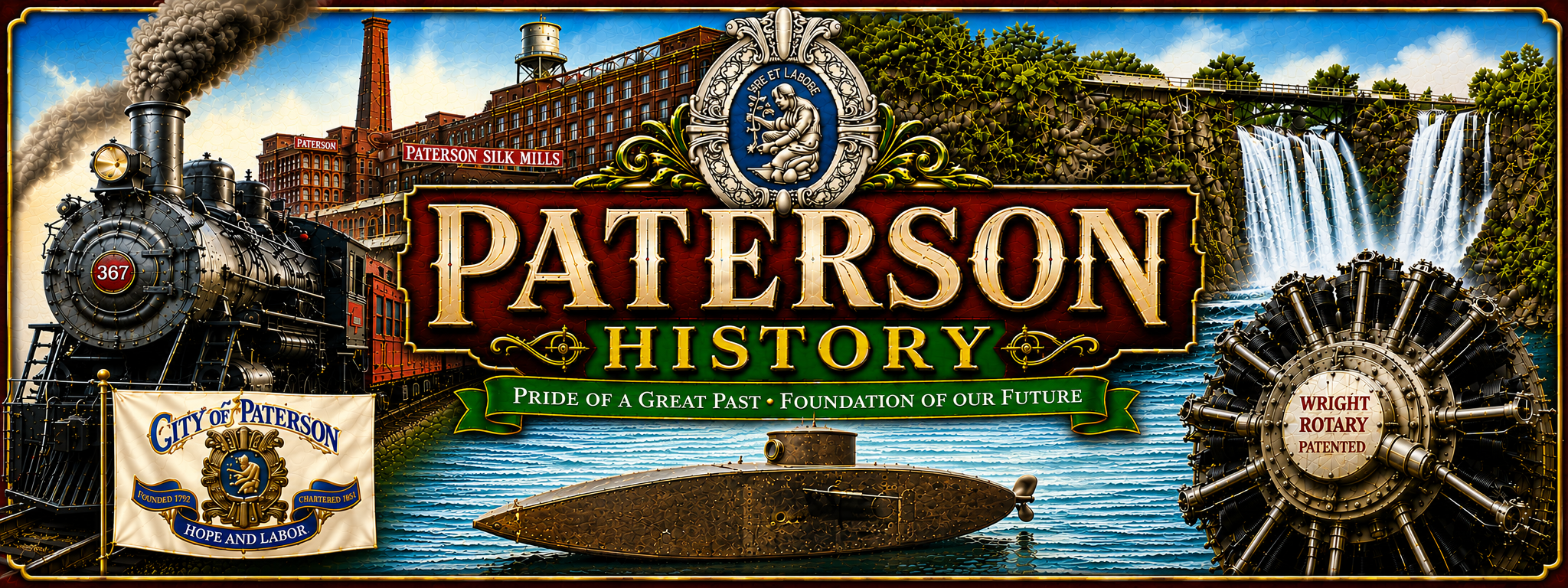


Downtown Paterson is the historic, commercial, and civic heart of Paterson, New Jersey. From the city’s founding in 1792 to the present day, it has served as the center of government, commerce, banking, transportation, and entertainment. Its remarkable collection of early twentieth-century architecture, combined with its industrial heritage, makes it one of New Jersey’s most significant historic downtowns.
A Planned Industrial City
Downtown Paterson owes its existence to Alexander Hamilton’s vision of creating America’s first planned industrial city. In 1791, Hamilton and the Society for Establishing Useful Manufactures (S.U.M.) selected the Great Falls of the Passaic River as the ideal location to harness waterpower for manufacturing. Paterson was officially established in 1792 and named after New Jersey Governor William Paterson. While the mills developed around the raceway system near the falls, the downtown commercial district quickly emerged just to the east, centered on Main Street, Market Street, Broadway, and Van Houten Street.
The Commercial Center of Northern New Jersey
By the mid-1800s, Downtown Paterson had become one of New Jersey’s busiest business districts. Banks, department stores, hotels, restaurants, theaters, and professional offices lined Main Street and Market Street. Residents from throughout Passaic, Bergen, Morris, and Sussex Counties traveled to Paterson to shop.
The city’s prosperity was fueled by its nationally known industries:
- Silk manufacturing, earning Paterson the title “Silk City.”
- Rogers Locomotive and Machine Works
- Firearms manufacturing
- Textile machinery
- Steam engines
- Brewing and food processing
Electric trolley lines and major railroad terminals connected downtown to surrounding communities, making it one of northern New Jersey’s premier shopping destinations.
The Great Fire of 1902
One of the defining events in downtown’s history occurred on February 9, 1902, when a catastrophic fire destroyed nearly thirty acres of the central business district. Hundreds of stores, offices, hotels, and commercial buildings were lost.
Rather than rebuilding cheaply, Paterson’s civic and business leaders transformed the disaster into an opportunity. During the next several years, the downtown was rebuilt with impressive Beaux-Arts, Classical Revival, Romanesque Revival, and Renaissance Revival buildings designed by some of New Jersey’s finest architects. Today, this reconstruction gives Paterson one of the finest collections of turn-of-the-century commercial architecture in the state.
Architectural Treasures
Downtown Paterson contains more than 200 historic contributing buildings within the Downtown Commercial Historic District.
Among its architectural highlights are:
- Paterson City Hall (1896), modeled after the Hôtel de Ville in Lyon, France
- Passaic County Courthouse Complex
- Paterson Free Public Library
- Cathedral of St. John the Baptist
- Former Fabian Theatre
- Former Orpheum Theatre
- Numerous early twentieth-century banks, office buildings, and department stores
Much of the district was designed by noted architect Fred Wesley Wentworth, whose work helped define Paterson’s distinctive architectural character.
A Cultural Crossroads
Throughout its history, Downtown Paterson welcomed successive waves of immigrants who shaped the city’s identity.
These communities included:
- Dutch
- English
- Irish
- Germans
- Italians
- Jews
- Syrians and Lebanese
- African Americans during the Great Migration
- Puerto Ricans
- Dominicans
- Peruvians
- Turks
- Bangladeshis
- Arabs
Each group established businesses, churches, restaurants, clubs, and cultural organizations that contributed to the neighborhood’s rich diversity. Today, Downtown Paterson remains one of the most culturally diverse urban centers in New Jersey.
Decline and Renewal
Following World War II, suburban shopping centers, highway construction, and the decline of manufacturing led to the gradual loss of downtown retailers and department stores. Urban renewal projects in the 1960s and 1970s also altered parts of the historic streetscape.
Despite these challenges, Downtown Paterson has retained much of its historic fabric. Preservation efforts beginning in the early 2000s led to the creation of the Downtown Commercial Historic District, encouraging restoration of historic buildings and protection of their architectural character.
Downtown Today
Today, Downtown Paterson continues to serve as the city’s governmental and commercial center. It is home to:
- Paterson City Hall
- Passaic County government offices
- State and federal agencies
- Passaic County Community College
- Retail businesses
- Restaurants representing dozens of cultures
- Financial institutions
- Professional offices
Its proximity to the Great Falls National Historical Park and Hinchliffe Stadium has renewed interest in heritage tourism and adaptive reuse of historic buildings. Ongoing revitalization efforts seek to preserve Downtown Paterson’s remarkable architectural legacy while supporting new housing, businesses, and cultural attractions.
Legacy
For more than two centuries, Downtown Paterson has reflected the city’s remarkable story of innovation, immigration, industry, and resilience. From Alexander Hamilton’s industrial experiment to the grand Beaux-Arts rebuilding after the Fire of 1902, downtown remains a living monument to the people who built one of America’s great manufacturing cities. Its historic buildings, vibrant streets, and diverse communities continue to embody the spirit of Paterson—New Jersey’s historic “Silk City.”