
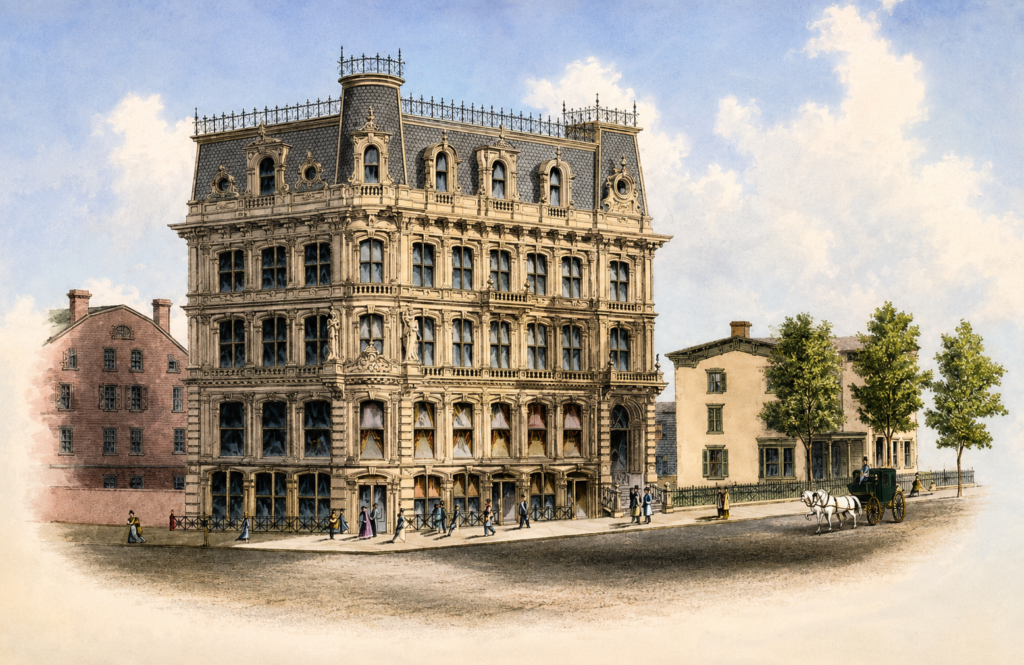
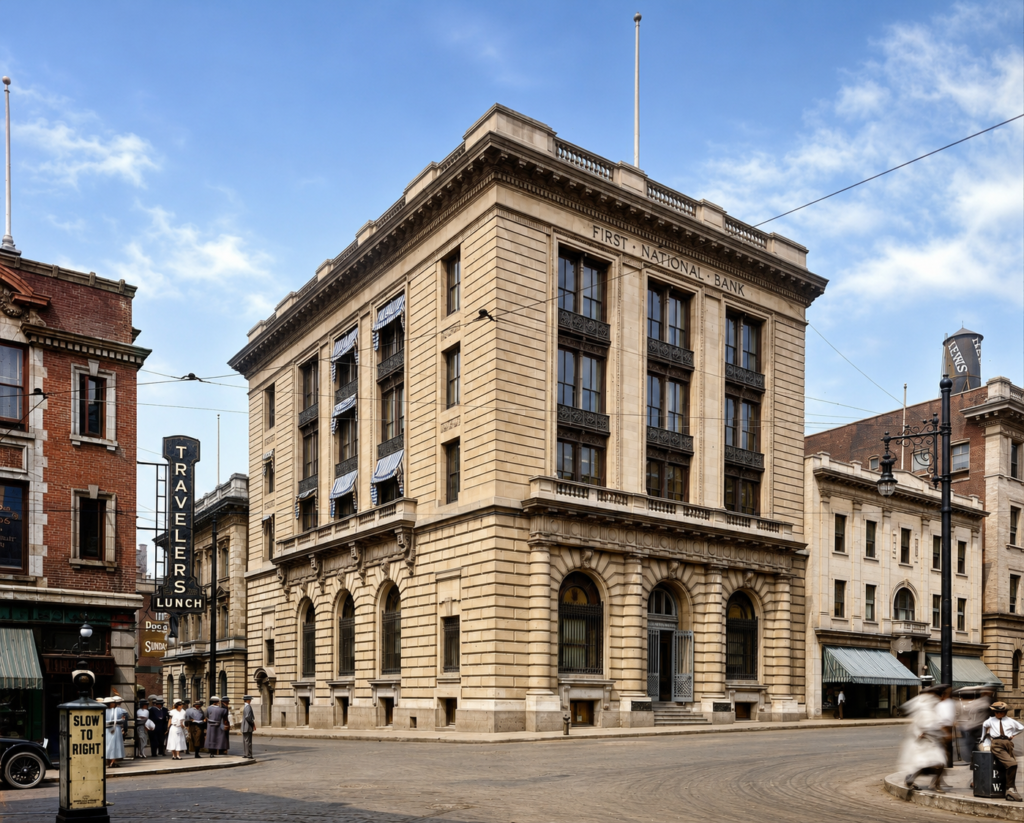
The First National Bank of Paterson was one of the city’s most influential financial institutions during the late nineteenth and early twentieth centuries. Organized in 1864, it was among the earliest banks chartered under the new federal National Banking Act, receiving National Charter No. 329. Its creation reflected the rapid industrial expansion of Paterson, then known as the “Silk City.”
Founding
The bank was established on August 2, 1864, during the Civil War. At the time, Congress had recently created the national banking system to provide a uniform national currency and strengthen the nation’s financial structure.
Paterson’s leading manufacturers, merchants, and industrialists organized the bank to serve the growing needs of local businesses. The city’s booming silk, locomotive, textile, and machinery industries required dependable banking services for payrolls, loans, and commercial transactions.
Early Locations
The bank first occupied a three-story brick building at 240 Main Street, formerly the residence of Colonel C. G. Garrison.
As business expanded rapidly, the bank moved on February 1, 1866, to larger quarters in the historic Congress Hall building at the northeast corner of Main and Market Streets, where it remained for several decades. Congress Hall was one of Paterson’s most prominent commercial buildings during the nineteenth century.
Leaders of Paterson Industry
The bank’s directors included many of the men who built Paterson into one of America’s greatest manufacturing cities. Among those associated with the bank were leaders of the locomotive, silk, and machinery industries, including members of the Rogers Locomotive Works and other major manufacturing firms.
These industrialists used the bank to finance factory expansion, commercial development, and municipal improvements. The First National Bank became one of the financial centers of Paterson’s industrial economy.
The 1902 Bank Building
Following the devastating Great Fire of Paterson in 1902, the bank constructed an impressive new headquarters at 125 Ellison Street, adjacent to the newly rebuilt City Hall.
Designed by the distinguished architectural firm Carrère and Hastings, the four-story Beaux-Arts building featured:
- Massive rusticated stone construction
- Monumental arched entrances
- Classical columns
- Decorative keystones
- A heavy cornice and parapet
The architects also designed the neighboring Paterson City Hall, giving the two buildings a harmonious civic appearance.
Role in Paterson’s Growth
During the late nineteenth and early twentieth centuries, the First National Bank financed many of the enterprises that made Paterson famous, including:
- Silk manufacturers
- Textile mills
- Locomotive builders
- Machine shops
- Commercial real estate
- Local merchants
The bank became one of the city’s most respected financial institutions and played a significant role in Paterson’s transformation into one of America’s foremost industrial centers.
Later History
As banking consolidated during the twentieth century, the First National Bank underwent several mergers and eventually became part of First National Bank of Passaic County. Over time, additional mergers brought the institution into larger regional banking organizations. Oral histories from Paterson residents note this succession of ownership through the twentieth century.
The Building Today
The former First National Bank building still stands at 125 Ellison Street in downtown Paterson. It is listed as a contributing building within the Downtown Commercial Historic District and today serves as the Paterson City Hall Annex. Its elegant Beaux-Arts architecture remains one of the finest surviving examples of early twentieth-century commercial architecture in the city.
Timeline
| Year | Event |
|---|---|
| 1864 | First National Bank of Paterson organized under National Charter No. 329 |
| 1864 | Opens at 240 Main Street |
| 1866 | Moves to Congress Hall at Main and Market Streets |
| 1902 | Great Fire destroys much of downtown Paterson |
| 1902–1903 | New headquarters built at 125 Ellison Street, designed by Carrère and Hastings |
| 20th century | Merges into First National Bank of Passaic County and later successor institutions |
| Today | Building serves as the Paterson City Hall Annex |
One of the best contemporary sources on the bank is the commemorative volume The First Half Century of the First National Bank of Paterson, New Jersey, 1864–1914, published by the bank in 1914. It provides detailed information on its founders, officers, directors, and early history