
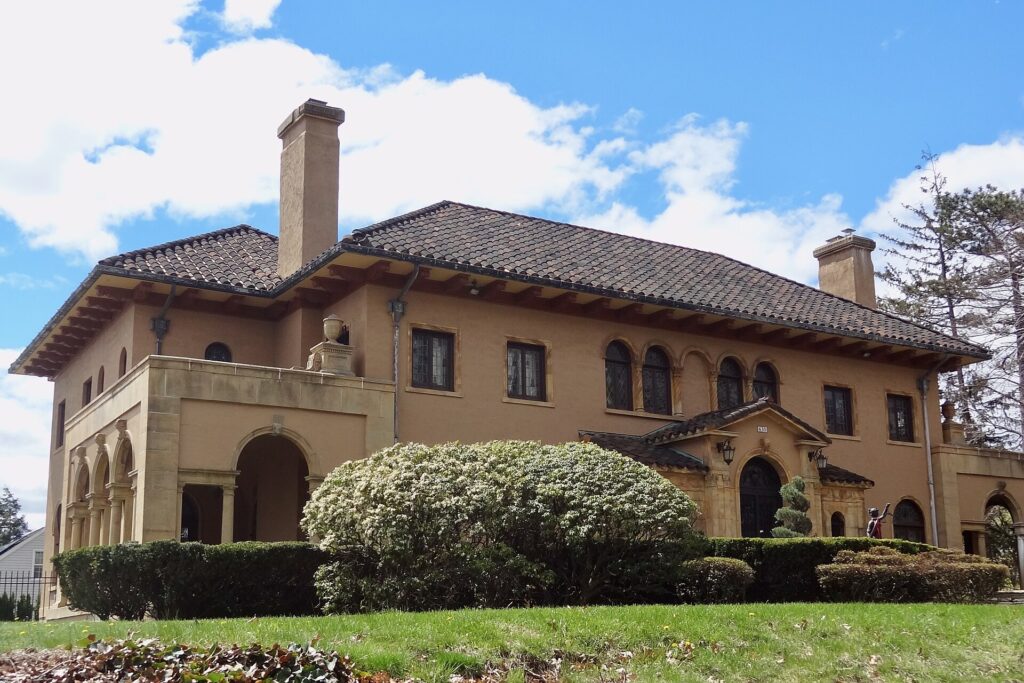
Jacob Weidmann Home
630 Park Avenue
Jacob Weidmann (1845–1911)
Jacob Weidmann was born in Switzerland in 1845. After learning advanced silk dyeing techniques in Switzerland, Germany, and France, he immigrated to the United States in 1867. He first worked for Cheney Brothers in Connecticut before moving to Paterson in 1872, where he established his own silk dyeing business.
The Weidmann Silk Dyeing Company
- Opened his first dye works at Paterson and Ellison Streets.
- Incorporated the Weidmann Silk Dyeing Company in 1881.
- Future U.S. Vice President Garret A. Hobart was one of the company’s directors.
- Specialized in high-quality black weighted silk and introduced many new European dyeing technologies to the American silk industry.
Expansion to Riverside
After a fire destroyed another dye works in Riverside, Weidmann purchased the property and moved his entire operation there in 1887.
The new plant:
- Occupied a vast industrial complex.
- Included its own chemical works.
- Had private tunnels beneath the railroad.
- Used artesian wells and a dedicated water supply from the Passaic River and Goffle Brook.
- Eventually employed about 3,000 workers, making it one of the largest silk dyeing plants in the United States.
The 1913 Paterson Silk Strike
Although Jacob Weidmann died in 1911 while on a fishing trip in Canada, his company became one of the principal employers involved in the famous 1913 Paterson Silk Strike. The company’s dye-house workers played a significant role in the labor movement led by the Industrial Workers of the World (IWW).
After Weidmann’s Death
- In 1909, Weidmann sold a controlling interest in the company to a French firm, Gillet et Fils.
- He died in 1911.
- The company was sold to United Piece Dye Works in 1923.
- Much of the historic industrial complex still survives today and is recognized as one of Paterson’s most significant silk industry landmarks.