
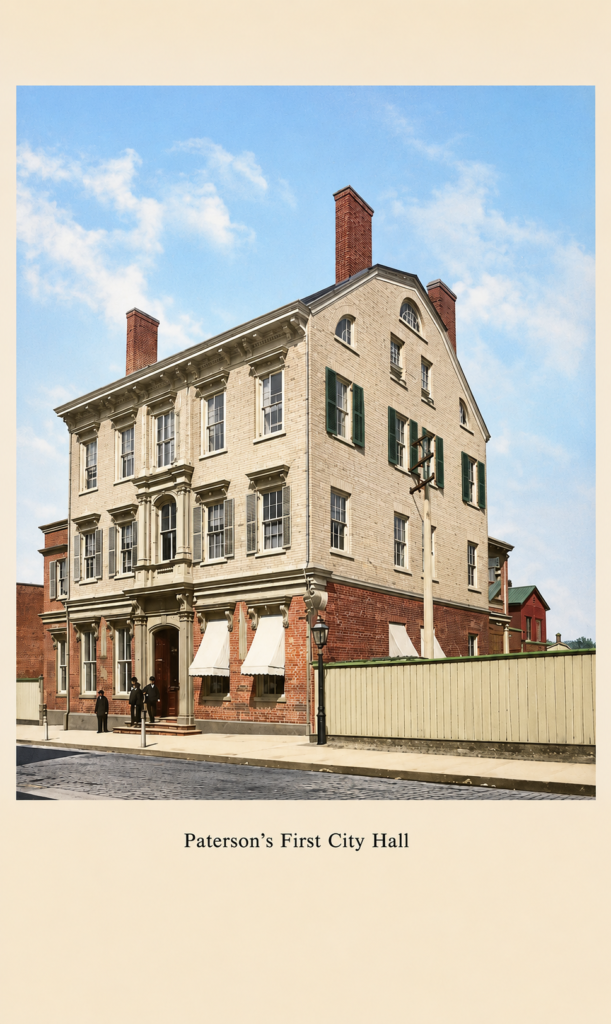
The Peter Colt House
Paterson’s First City Hall
The Peter Colt Residence, completed in 1813, was one of the most important early homes in Paterson, New Jersey. Built for Peter Colt (1744–1824), superintendent of the Society for Establishing Useful Manufactures (S.U.M.), it served as both his family home and a landmark overlooking the young industrial village.
Construction and Architecture
Peter Colt began construction around 1811, moving into the completed residence on July 4, 1813. The house occupied the crest of a hill bounded today by Main, Church, Ellison, and Washington Streets. At the time it commanded sweeping views over Paterson and the Passaic Valley.
One of the home’s most unusual features was its construction materials. Much of the dressed brownstone used for the west and south walls came from the ruins of the S.U.M.’s massive four-story stone cotton mill, which had burned in 1808. The remaining walls were built of local fieldstone.
The property included:
- A broad sloping lawn extending to Main Street.
- Formal gardens stretching nearly to Church Street.
- Orchards, shrubs, vegetables, and shade trees.
- A carriage drive leading up the hill to the residence.
At the time, it was widely regarded as Paterson’s finest private residence.
Peter Colt’s Home
Peter Colt was already nearly 70 years old when he moved into the mansion. Although officially retired from the day-to-day management of the S.U.M., he remained active supervising improvements and advising the organization.
His son John Colt and daughter-in-law Elizabeth Boudinot Colt also lived there after their marriage in 1814, making the mansion the center of one of Paterson’s leading industrial families.
Peter Colt died in the house in March 1824, at the age of 80.
Conversion into Paterson’s First City Hall
In 1869, the City of Paterson purchased the Colt residence for municipal use after plans for a new civic complex were abandoned.
To adapt the house:
- Washington Street was cut through the hill in front of the building.
- Because the excavation left the original first floor elevated above street level, an entirely new ground floor was constructed beneath the original structure.
- The former front entrance became the second-story entrance, a feature clearly visible in historic photographs.
The building served as Paterson’s first City Hall until the present City Hall was constructed in the 1890s.
Destruction
The former Colt residence was destroyed during Paterson’s Great Fire of 1902, ending nearly ninety years of continuous use.
Historical Significance
The Peter Colt Residence was significant because it:
- Was one of the earliest and grandest residences in Paterson.
- Reflected the leadership of Peter Colt in developing the S.U.M. and the nation’s first planned industrial city.
- Demonstrated the reuse of stone from Paterson’s first large cotton mill.
- Served as Paterson’s first City Hall for over two decades.
- Occupied a prominent site in the city’s early civic and industrial landscape.
The house stood on or near the site later occupied by the old police headquarters, adjacent to today’s City Hall complex, making it a cornerstone of Paterson’s early civic history.