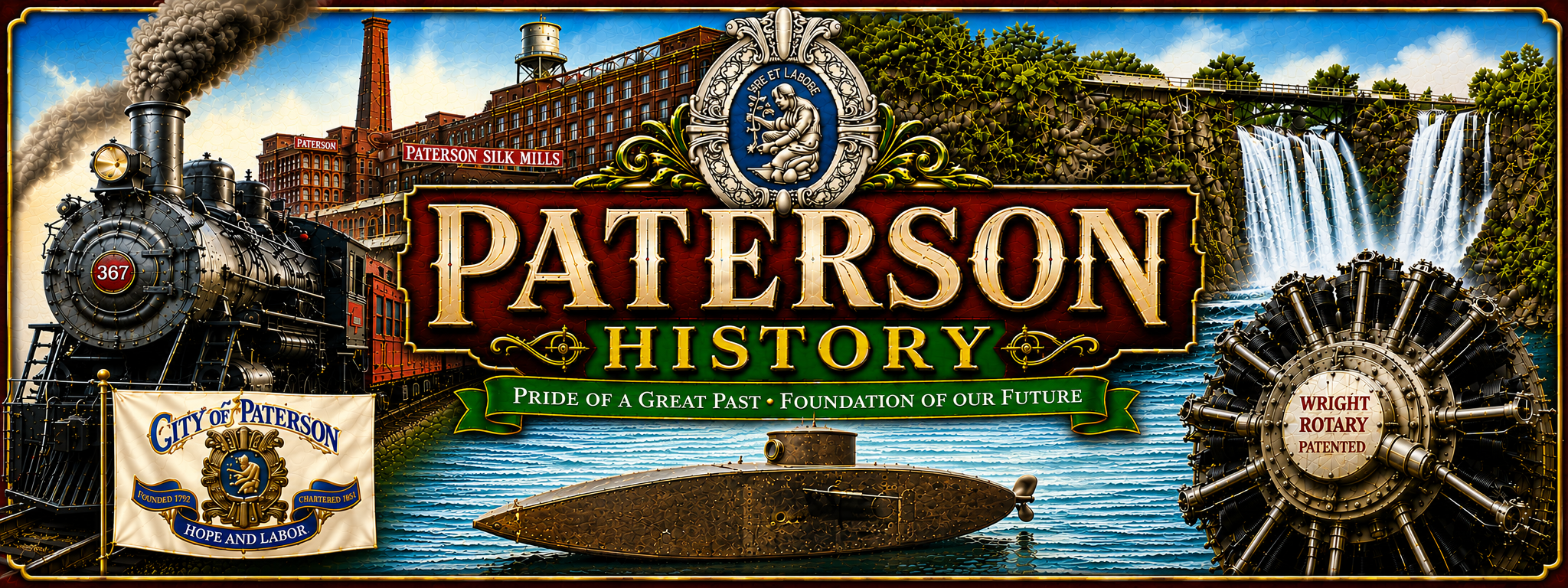
For more than a century, the Great Falls of the Passaic River and Paterson’s raceway system provided the mechanical energy that helped make the city one of America’s great manufacturing centers.
The raceways powered textile mills, machine shops, locomotive works, firearms manufacturers, wire mills and eventually the factories that made Paterson famous as the “Silk City.”
But technology changed.
Beginning in the nineteenth century, new sources of energy—first steam and eventually electricity—gradually reduced the importance of direct waterpower.
The decline was not sudden. For decades, waterpower, steam and later electricity operated alongside one another.
The Limitations of Waterpower
Waterpower had one major disadvantage:
The amount of power available depended upon the river.
The Passaic River did not always provide the same amount of water.
Periods of:
- drought
- low rainfall
- seasonal changes
- flooding
- ice
could affect the operation of the raceway system.
When water levels were low, factories could experience reduced power.
For a small mill, this might be manageable.
For a large factory employing hundreds of workers, interruptions could be costly.
As manufacturing became larger and more mechanized, dependable power became increasingly important.
The Rise of Steam Power
The most important early competitor to waterpower was steam.
Steam engines offered manufacturers something the raceways could not:
independence from the river.
A factory equipped with a steam engine could generate its own mechanical power.
The basic process was:
Coal
↓
Boiler
↓
Steam
↓
Steam Engine
↓
Rotating Shaft
↓
Factory Machinery
This gave manufacturers much greater control over their operations.
Steam engines could operate during periods when water levels were inadequate.
Waterpower and Steam Worked Together
The introduction of steam did not immediately eliminate waterpower.
For many years, Paterson factories used both.
A manufacturer might use waterpower when sufficient water was available and supplement it with steam when necessary.
This provided greater reliability.
The combination allowed Paterson’s industrial economy to continue growing even as the limitations of the raceway system became increasingly apparent.
The raceways therefore remained important throughout much of the nineteenth century.
Steam Changes Factory Location
Waterpower imposed a major geographical limitation.
A factory using a raceway had to be located where water could be delivered at a useful elevation.
Steam power changed that equation.
A steam-powered factory could be constructed wherever there was sufficient land, transportation and access to fuel.
The factory no longer needed to sit beside a raceway.
This gradually weakened the connection between industry and the Great Falls.
The Changing Industrial Landscape
As steam power became more common, Paterson’s industrial landscape began to change.
Factories could expand beyond the immediate raceway district.
Manufacturers could locate closer to railroads and transportation facilities.
Larger industrial buildings could be constructed without being designed around a waterwheel or turbine.
The raceways remained important, but they were no longer the only possible source of industrial energy.
The Rise of Electricity
The next great transformation was electric power.
Electricity offered advantages that neither waterpower nor steam could easily match.
Power could be transmitted over wires.
Factories could install electric motors close to individual machines.
Instead of using one central waterwheel connected to a complicated network of shafts and belts, a factory could increasingly use separate electric motors.
This changed factory design.
Electricity and the End of the Mechanical Power Shaft
The traditional water-powered factory often depended upon a central power shaft.
The shaft could run through an entire building.
Belts connected the shaft to individual machines.
This system was mechanically complex.
Electricity simplified the arrangement.
A motor could be installed directly beside a machine.
The result was greater flexibility in factory layout and operation.
The industrial process was becoming increasingly independent of the raceway.
The Raceways Lose Their Industrial Function
As electricity became increasingly available, the historic raceways gradually lost their importance as Paterson’s primary industrial power network.
Factories no longer needed direct access to waterpower.
Some continued using the raceways for a period.
Others converted to steam or electric power.
Eventually, many factories closed or moved entirely away from the old waterpower district.
The raceways remained physically present even though their original function was disappearing.
The Decline of Paterson’s Industrial Economy
The decline of waterpower was only one part of a much larger transformation.
During the twentieth century, Paterson faced increasing competition from other manufacturing centers.
Silk production moved to other locations.
Factories became obsolete.
Manufacturing technology changed.
Foreign competition increased.
Labor costs and working conditions changed.
Many historic industrial buildings were abandoned or demolished.
The decline of direct waterpower therefore occurred alongside the broader decline of Paterson’s traditional manufacturing economy.
The Raceways Fall Silent
For generations, the raceways had been associated with the sounds of industrial activity:
- water rushing through channels
- waterwheels turning
- turbines rotating
- machinery operating
- factory whistles
- workers arriving for shifts
As factories closed, the soundscape changed.
The water continued to flow, but the machinery increasingly disappeared.
The raceways that had once been essential industrial infrastructure gradually became historic remnants.
Some Raceways Were Altered or Covered
As the industrial district changed, portions of the raceway system were:
- filled
- covered
- altered
- incorporated into later construction
- allowed to deteriorate
Other portions survived.
The surviving sections are especially valuable because they allow historians and visitors to reconstruct the original waterpower system.
Waterpower Returns in a New Form
The story of waterpower in Paterson did not completely end.
Although the historic raceways largely ceased to provide direct mechanical power to factories, the Great Falls continues to be used for hydroelectric generation.
Modern hydroelectric technology converts the energy of falling water into electricity rather than directly turning factory machinery.
This represents an important technological continuation of the original concept.
The technology changed:
Old system:
Water → Waterwheel → Factory Machinery
Modern system:
Water → Turbine → Generator → Electricity
The basic principle remains the same:
Use the energy of the Falls.
From Industrial Infrastructure to Historic Resource
By the twentieth century, the raceways had changed from working industrial infrastructure into historic resources.
Their importance was no longer measured by how much machinery they could operate.
Instead, they became evidence of the technological history of Paterson.
The raceways preserve the story of how an early American industrial city was powered.
Preservation
Preservation efforts eventually recognized that the raceways were an essential part of Paterson’s industrial heritage.
The Great Falls and surrounding industrial structures were preserved as historic resources.
The establishment of Paterson Great Falls National Historical Park helped ensure that the raceways, mill buildings, dams and other features could be interpreted together as part of the city’s industrial story.
The raceways are particularly valuable because they provide a physical connection between the natural landscape and the industrial development that followed.
What the Decline of Waterpower Changed
The decline of waterpower fundamentally changed Paterson.
When factories depended upon the raceways, the Great Falls determined where industrial development could occur.
Once electricity became widely available, that limitation disappeared.
Factories could be located wherever transportation, labor, land and markets made economic sense.
The Great Falls was no longer the indispensable power source for every factory.
But it remained the historic reason Paterson became an industrial city in the first place.
A New Era
The decline of waterpower was not simply the end of an old technology.
It marked the transition from one industrial era to another.
Paterson moved from:
Waterpower
→
Waterpower + Steam
→
Steam + Electricity
→
Modern Electric Power
The raceways were eventually bypassed by newer technologies, but they had already accomplished their historic purpose.
They had helped establish Paterson as a major manufacturing center.
The Legacy
Today, a quiet raceway can be easy to overlook.
Yet beneath the surface is the story of a technological revolution.
The same water that once turned massive wheels and powered factory machinery helped create the industrial city of Paterson.
The raceways eventually became obsolete, but their historical significance increased as their original function disappeared.
Waterpower built Paterson’s industrial foundation.
Steam challenged it.
Electricity replaced it.
But the raceways remain to tell the story.
The decline of waterpower was therefore not the end of the Great Falls’ importance.
It was the end of an era—and the beginning of the Great Falls’ transformation from an industrial power source into one of Paterson’s most important historic landmarks.