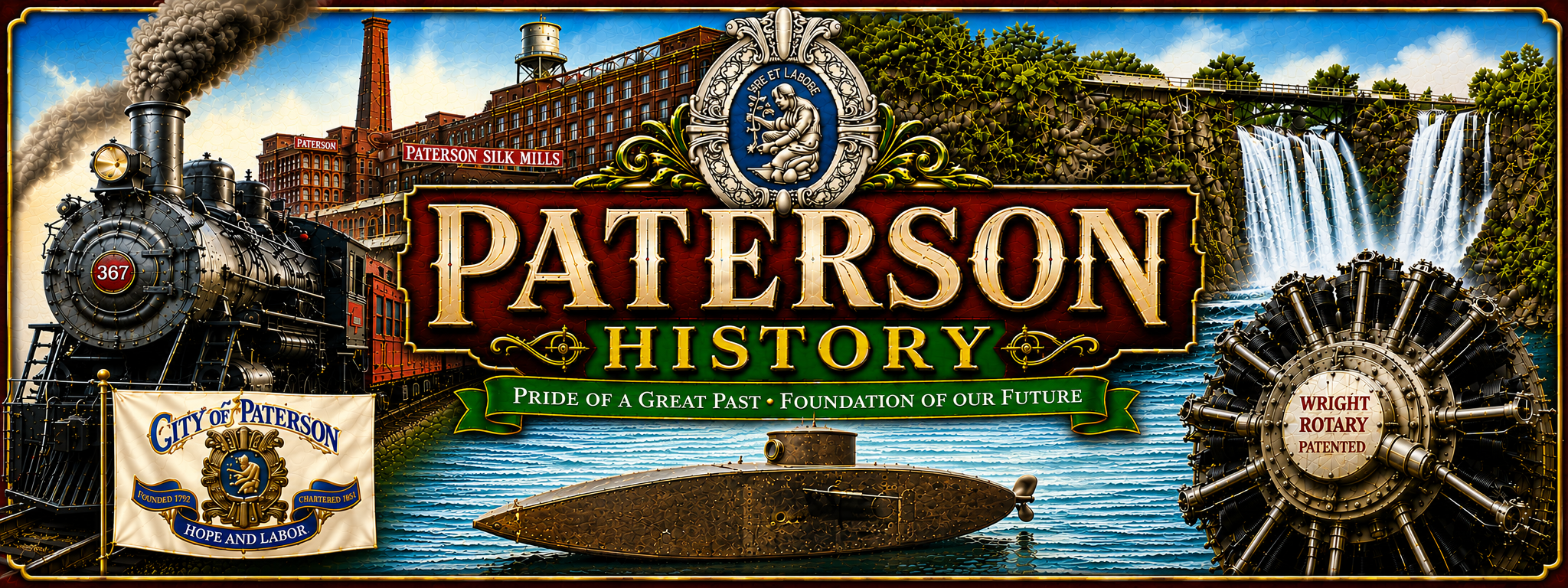
Paterson’s identity as the “Silk City” was built upon more than the skill of its silk manufacturers and workers. It also depended upon an industrial infrastructure that had been developing around the Great Falls of the Passaic River for more than a century.
By the time silk became Paterson’s dominant industry, the city’s raceway system had already transformed the Great Falls into an established source of industrial power.
The raceways provided the foundation upon which the silk industry developed, expanded and eventually became one of the most important silk-producing centers in the United States.
From Waterpower to Silk
Paterson’s first industrial experiments centered on cotton and other manufacturing during the late eighteenth and early nineteenth centuries.
The raceway system expanded as factories were built around the Great Falls.
During the nineteenth century, Paterson developed a remarkable range of industries, including:
- cotton manufacturing
- firearms
- machinery
- locomotives
- wire
- paper
- textiles
Silk eventually became the industry for which Paterson was best known.
The important point is that the silk industry did not create Paterson’s waterpower system.
The raceways came first.
By the time silk manufacturing expanded dramatically, Paterson already possessed an industrial landscape with mills, water channels, power structures, transportation routes and a skilled manufacturing workforce.
The Arrival of Silk Manufacturing
Silk manufacturing began developing in Paterson during the nineteenth century and expanded significantly during the later decades of the century.
The city possessed several advantages for silk manufacturers:
- established factories
- available industrial space
- mechanical power
- transportation connections
- skilled workers
- access to New York markets
- an established immigrant labor force
- experienced machinery manufacturers
The raceways were an important part of this industrial environment.
They provided access to mechanical power for mills located along the waterpower system.
How Silk Mills Used Waterpower
Silk manufacturing involved numerous mechanical operations.
Depending upon the particular mill, machinery might be used for:
- reeling silk
- winding thread
- twisting fibers
- spinning
- warping
- weaving
- finishing
These processes required machinery that had to operate at relatively consistent speeds.
Before electric motors became commonplace, mechanical power could be supplied through the traditional system of:
Water → Waterwheel/Turbine → Main Shaft → Pulleys → Belts → Machines
The raceway supplied the water.
The wheel or turbine supplied the mechanical rotation.
The factory’s shafts and belts distributed that power throughout the building.
The Silk Mill and the Raceway
The architecture of Paterson’s silk mills was influenced by the need for mechanical power.
A mill located along a raceway could be designed with its power system positioned close to the water.
Water entered through a controlled gate.
It passed through the wheelhouse or turbine system.
The resulting mechanical energy was transmitted into the mill.
After passing through the machinery, the water exited through a tailrace.
Thus the raceway was physically connected to the factory.
It was not simply located near the mill.
It was part of the mill’s power system.
The Silk Industry Expands
During the late nineteenth century, Paterson’s silk industry expanded rapidly.
The city attracted manufacturers and workers with an established industrial infrastructure.
Factories that had previously been devoted to other products could be adapted for silk production.
New silk mills were also constructed.
The expanding industry transformed Paterson’s economy and population.
Workers from many countries came to the city seeking employment in its factories.
Italian immigrants became particularly important to the silk industry, along with workers from other immigrant communities.
The factories surrounding the raceways became places where these communities worked and built new lives.
The Raceways and Industrial Concentration
One of the major advantages of Paterson’s raceway system was that it encouraged industrial concentration.
Factories were clustered around the available waterpower.
This created a dense manufacturing district around the Great Falls.
Silk manufacturers could therefore benefit from an existing industrial ecosystem.
Nearby were:
- machinery manufacturers
- dyeing and finishing businesses
- suppliers
- skilled mechanics
- transportation facilities
- warehouses
- laborers
- other textile manufacturers
Paterson’s industrial infrastructure supported the silk industry far beyond the waterpower alone.
Machinery Made in Paterson
An especially important feature of Paterson’s industrial development was the relationship between manufacturing machinery and manufacturing textiles.
Paterson was already a major center of machinery production before silk became dominant.
Local manufacturers could design and build specialized machinery for textile production.
This created a powerful industrial relationship:
Machine makers → Textile mills → Silk manufacturers → Markets
The raceways provided part of the mechanical power that supported this industrial ecosystem.
From Waterpower to Steam
The silk industry also demonstrates the gradual decline of direct waterpower.
As silk mills expanded, manufacturers needed reliable power.
Water flow could vary with weather and seasonal conditions.
Steam engines therefore became increasingly important.
A silk mill might use waterpower when available while supplementing it with steam.
This reduced the industry’s dependence on the raceways.
Steam also made it possible for manufacturers to locate factories farther from the most desirable waterpower sites.
Electricity Transforms Silk Manufacturing
The introduction of electricity produced an even greater change.
Electric motors could be installed close to individual machines.
Instead of using a large central waterwheel to power a system of shafts and belts, a factory could increasingly use electric motors to drive equipment.
This eliminated many of the limitations associated with mechanical power transmission.
The raceways gradually became less important to silk production.
Yet the industrial buildings and raceways remained physically connected to the city’s manufacturing history.
Paterson Becomes the Silk City
By the late nineteenth and early twentieth centuries, silk had become so closely associated with Paterson that the city earned its famous nickname:
The Silk City
Paterson’s silk products reached markets throughout the United States and internationally.
The industry supported thousands of workers and became one of the city’s most important economic foundations.
But behind the silk mills was an older infrastructure.
The raceways had been built decades before the great expansion of silk manufacturing.
They had helped establish the industrial landscape that made Paterson attractive to silk manufacturers in the first place.
Labor and the Silk Industry
The silk industry also played a major role in Paterson’s labor history.
Silk manufacturing employed large numbers of immigrant workers, including women and children.
Working conditions, wages and hours became major issues.
The industrial concentration created by the mills also made Paterson an important center of labor organizing.
The most famous example was the Paterson Silk Strike of 1913.
Thousands of silk workers participated in the strike, which became one of the most significant labor conflicts in the city’s history.
Although the raceways were no longer the central issue in the strike, the industrial landscape created around them provided the physical setting for Paterson’s textile economy.
The Raceways After the Silk Era
The decline of Paterson’s silk industry during the twentieth century had a profound effect on the city’s industrial district.
Factories closed or relocated.
Some mill buildings were demolished.
Others were converted to new uses.
The raceways gradually ceased to function as the primary source of power.
Yet many portions of the system survived.
Today, the raceways provide an important physical connection between the Great Falls and the factories that once surrounded it.
Preserving the Silk City’s Industrial Landscape
The surviving raceways are particularly important when interpreted together with Paterson’s historic silk mills.
A visitor can see how the system worked:
Passaic River
↓
Dam
↓
Upper Raceway
↓
Mill Gate
↓
Waterwheel / Turbine
↓
Silk Mill
↓
Machinery
↓
Tailrace
↓
Middle / Lower Raceway
This relationship helps explain why Paterson’s industrial buildings were located where they were.
The mills were not randomly scattered throughout the city.
They were connected to the infrastructure that supplied their power.
The Raceways and the Silk City Legacy
The raceways did not manufacture silk.
Workers, manufacturers, machinery and entrepreneurial investment made the silk industry possible.
But the raceways helped create the industrial foundation upon which the silk industry developed.
Their importance can be understood in three stages:
1. The Raceways Created Industrial Paterson
Beginning in the 1790s, the waterpower system attracted manufacturing to the Great Falls.
2. Industrial Paterson Created the Environment for Silk
Factories, workers, machinery manufacturers and transportation networks developed around the industrial district.
3. Silk Became Paterson’s Signature Industry
By the late nineteenth century, silk manufacturing had become one of the city’s defining industries.
Thus, the raceways were part of a chain of development stretching from the Great Falls to the Silk City.
A Legacy Written in Water
Today, the surviving raceways may appear quiet.
There are no longer rows of silk workers arriving for their shifts beside the channels.
The water no longer drives the vast network of factory machinery that once surrounded the Great Falls.
But the raceways remain.
They preserve the physical connection between the Passaic River and Paterson’s industrial history.
When visitors look at a surviving raceway, they are looking at infrastructure that helped power the factories where generations of Paterson workers produced silk for markets across America and the world.
Before Paterson became the Silk City, it became an industrial city powered by water.
The raceways provided that power.
The mills transformed it into products.
And the silk industry transformed Paterson’s identity.
The story of Paterson’s silk industry cannot be fully understood without understanding the raceways that helped make the city’s industrial development possible.