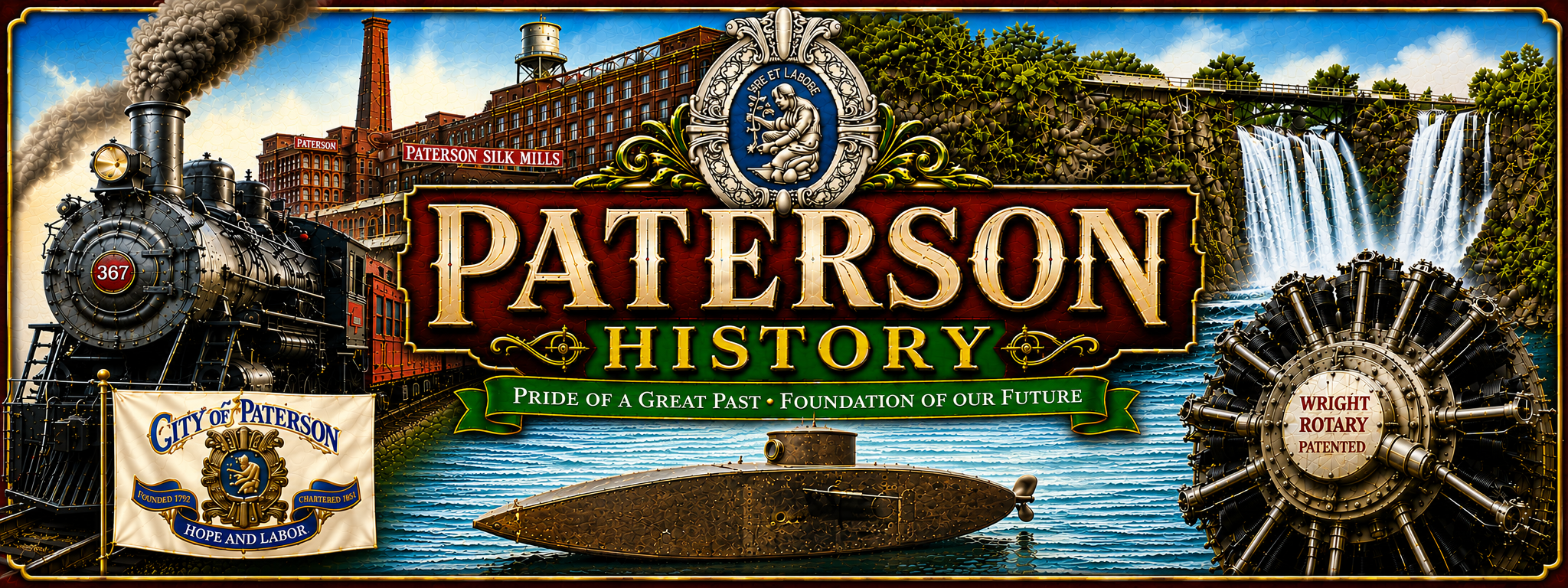
The history of Paterson’s industrial development begins with the Society for Establishing Useful Manufactures (S.U.M.) and its decision to harness the enormous waterpower of the Great Falls of the Passaic River.
The S.U.M. was established in 1791, largely through the efforts of Alexander Hamilton, who believed that the young United States needed to develop a strong domestic manufacturing economy. Rather than depending upon imported manufactured goods, Hamilton envisioned American factories producing textiles, machinery, tools and other products within the new nation.
The Great Falls offered an extraordinary opportunity to put this idea into practice.
Discovering the Industrial Potential of the Falls
The Great Falls of the Passaic River had been known to Native Americans and European settlers for generations, but Hamilton and the S.U.M. viewed the Falls differently. To them, the Falls represented an enormous source of mechanical energy.
The river drops approximately 77 feet at the Falls. In the eighteenth century, that falling water represented one of the most powerful naturally occurring sources of energy available to engineers.
The S.U.M. therefore sought to transform the Falls from a natural feature into the power center of an industrial community.
In 1792, the S.U.M. selected the Great Falls as the site of its proposed manufacturing settlement.
The S.U.M. Acquires the Land
The organization acquired extensive property surrounding the Falls and began laying out its industrial development.
The location had several advantages:
- The Great Falls provided abundant waterpower.
- The Passaic River supplied a continuing source of water.
- The surrounding land provided room for factories and a growing community.
- The area was within reach of New York City and other important markets.
- The river and developing roads provided transportation opportunities.
The S.U.M. intended to control the entire industrial environment—from the waterpower to the mill sites.
The First Raceway
One of the S.U.M.’s most important projects was the construction of a raceway, an artificial channel designed to divert water from the Passaic River and deliver it to factories.
Pierre Charles L’Enfant was brought to Paterson to develop plans for the new industrial settlement and its waterpower system.
The basic principle was straightforward but revolutionary for its time:
River → Dam → Raceway → Waterwheel → Factory → Tailrace → River
Instead of allowing the water to simply pass over the Falls, engineers could control its movement and extract useful mechanical energy from it.
The first raceway system was developed during the 1790s.
The First Manufacturing Experiment
The S.U.M. constructed its first manufacturing facilities near the Great Falls. Among the earliest ventures was a cotton mill, representing an attempt to establish large-scale textile manufacturing in the United States.
The early experiment encountered serious financial and management difficulties. The S.U.M. discovered that operating factories was considerably more complicated than simply providing waterpower.
Rather than becoming a major manufacturer itself, the organization gradually developed a different business model.
The S.U.M. Becomes the Power Company
The S.U.M. increasingly concentrated on what it controlled best:
land and waterpower.
The organization leased industrial sites to private manufacturers and charged for access to the waterpower supplied through its raceway system.
This arrangement proved enormously important to Paterson’s future.
Entrepreneurs could establish factories without having to develop their own independent power source. The S.U.M. provided the essential infrastructure while individual manufacturers operated their businesses.
The Great Falls effectively became the center of an early American industrial power district.
Expansion of the Raceway System
As more manufacturers arrived, the original raceway system proved insufficient.
The S.U.M. expanded the network, eventually developing the Upper, Middle and Lower Raceways.
This allowed water to be used at multiple elevations.
Water entering the upper portion of the system could first power machinery at a higher elevation. It could then continue downward and provide power to additional factories.
The result was an ingenious system that extracted increasingly more useful energy from the elevation created by the Great Falls.
Paterson Begins to Grow
The S.U.M.’s development of the Great Falls attracted manufacturers, mechanics, engineers and workers.
Factories began filling the industrial district surrounding the raceways.
Housing and commercial development followed.
The settlement that grew around the industrial complex eventually became the City of Paterson.
The relationship between the S.U.M., the Falls and the developing city was therefore fundamental:
The Great Falls provided the natural energy.
The S.U.M. developed the infrastructure.
The raceways distributed the power.
Manufacturers used the power to operate their factories.
Workers came to Paterson to work in those factories.
The industrial community became the City of Paterson.
A Foundation for Paterson’s Industrial Future
The S.U.M. did not immediately create the great industrial city that Paterson would eventually become. The company’s early manufacturing ventures experienced setbacks, and industrial development proceeded slowly.
But the basic infrastructure survived.
During the nineteenth century, new manufacturers took advantage of the waterpower system. Paterson developed industries producing cotton goods, machinery, locomotives, firearms, wire, paper and silk.
The Great Falls and raceways became the foundation upon which these industries were built.
The S.U.M.’s greatest contribution to Paterson was therefore not any particular factory.
It was the creation of an industrial waterpower system that allowed generations of manufacturers to establish businesses around the Falls.
The Legacy of the S.U.M.
The Society for Establishing Useful Manufactures represents one of the earliest attempts in the United States to deliberately create an industrial city around a planned power system.
Its legacy can still be seen throughout the Great Falls Historic District.
The surviving raceways, mill buildings, wheelhouses, dams and other structures preserve the physical evidence of that experiment.
What began in the 1790s as Alexander Hamilton’s vision for an American manufacturing center eventually became one of the most important industrial landscapes in the United States.
The S.U.M. came to the Great Falls seeking power.
It found the foundation of a city.